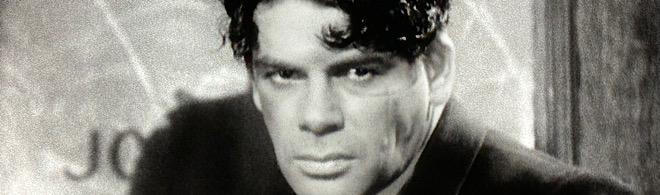
Scarface (1932) - The Criterion Collection 4K Ultra HD Blu-ray
One of the best gangster movies ever made, the original 1932 version of Scarface remains a dazzling account of the rise and fall of a Chicago crime boss who bears a striking resemblance to Al Capone. Criterion's 4K presentation lacks an HDR grade but greatly improves upon previous Blu-ray releases. If you haven't yet seen this iconic classic, this is the version to own. Highly Recommended.
Storyline: Our Reviewer's Take

More than 90 years after their respective releases, Little Caesar, The Public Enemy, and Scarface remain the holy trinity of Hollywood gangster films. The three violent pre-Code thrillers blazed their way to box office success in the early 1930s and provided an enduring template for a genre that continues to captivate viewers today. Though the first two movies may be better known and have certainly attracted wider audiences over the past nine decades (eccentric producer Howard Hughes pulled Scarface from circulation in the early 1940s and locked it away in a vault, where it remained until after his death in 1976), Scarface looms above them, packing more action, artistry, titillation, and grit into its 93 minutes than Little Caesar and The Public Enemy combined. Not only is Scarface the quintessential gangster picture, it also stands as arguably the greatest gangster flick of all time.
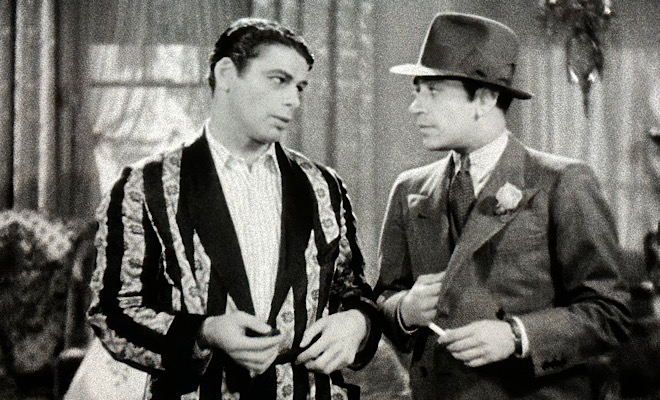
Not so loosely based on the rise of Chicago mobster Al Capone (the names were changed to protect the innocent people making the movie from the story's guilty - and dangerous - subjects), Scarface tells a simple, straightforward tale of greed, power, ego, and violence with enormous style and vigor. As the film opens, small-time hood and hitman Tony Camonte (Paul Muni), who wears an X-shaped scar on his left cheek like a badge of honor, elevates his status in Johnny Lovo's South Side bootlegging gang by bumping off a rival mob boss. Lovo (Osgood Perkins) warns the ambitious, cocky Tony to respect the Windy City's North Side syndicate, run by dapper don Tom Gaffney (Boris Karloff), but Tony believes he can conquer the territory and wages a violent turf war that consumes Chicago and terrorizes its residents.
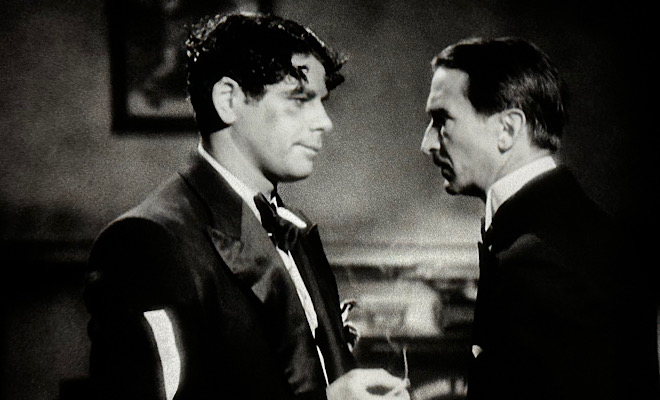
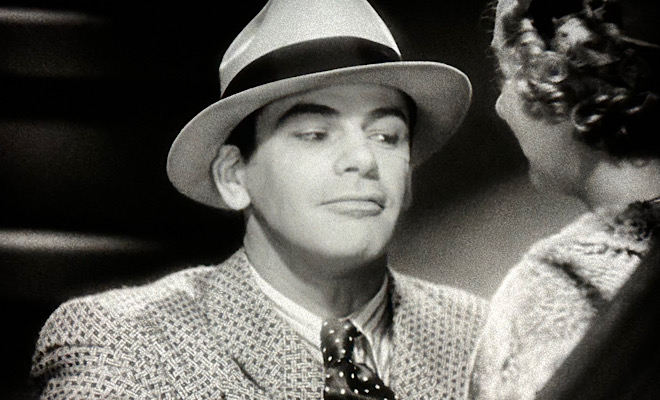
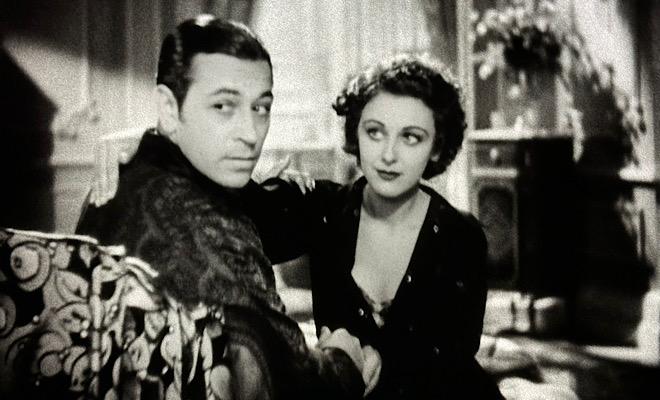
As the body count rises, so does Tony's reputation and renown. Not only does he begin usurping Lovo's position within the gang, he also catches the eye of his boss's sassy society girlfriend Poppy (Karen Morley). While their romance heats up, Tony's 18-year-old, wild-child sister Cesca (Ann Dvorak) sets her sights on Guino Rinaldo (George Raft), Tony's loyal sidekick. Their liaison enrages Tony, who harbors a deep-seated incestuous desire for Cesca that sparks apoplectic fits whenever another man touches her. His jealousy, along with Lovo's desperate mob maneuvers, spark a string of events that threaten to topple Tony from his precarious perch on top of the crime world.
Scarface is a visceral thrill ride from start to finish. With customary panache, director Howard Hawks pulls out all the stops, crafting exciting shootouts, impressive car chases (a novelty at the time), tense confrontations, and sexy exchanges. His bold brush strokes excite the senses, but Ben Hecht's crackling script laces the stimuli with subtle nuances, provocative subtext, and a liberal sprinkling of arch comedy that (slightly) tempers the prevailing nastiness. (Such accomplished scribes as W.R. Burnett, John Lee Mahin, and Seton I. Miller also contributed to the screenplay.) Hughes vowed to make Scarface bigger, brasher, and more violent than any gangster film before it, and despite Herculean censorship struggles, he and Hawks succeeded.
Though the rigid Production Code that would sanitize motion pictures for decades to come had yet to be enacted, the censors still gave Hollywood headaches, and at a time when real-life racketeers like Capone seduced Depression-weary Americans, concerns over the graphic depiction of violence and glamorization of the opulent, amoral, and corrupt gangster lifestyle prompted the Hays Office to clamp down on Scarface prior to its release. A written prologue denouncing the gangster culture and beseeching the public's help in quashing it was added along with preachy speeches by a crusty newspaper editor and outraged district attorney, who makes an impassioned plea to "pass a federal law that puts a gun in the same class as drugs and white slavery." An alternate ending was also shot and incorporated into prints that would be screened in regions that banned the original cut. (For more on the alternate ending, check out the supplements review below.)
Controversy may have dogged Scarface before and after its release, but there's nothing controversial about the high-voltage performances that juice up this electrifying film. Scarface put Muni on the Hollywood map, and though his broad portrayal occasionally crosses the line into caricature, it perfectly suits such a flamboyant larger-than-life figure. Of course, it's tough not to compare Muni's Tony Camonte to Al Pacino's Tony Montana in Brian De Palma's 1983 quasi-remake, but while both esteemed actors voraciously chew the scenery, Muni better gets under his Tony's skin and disappears inside him. (Always insecure about his looks, Muni often hid behind thick makeup in his movies, usually to great effect.) His scenes with the equally magnetic Dvorak - whether creepy, bruising, or tender - are raw and affecting, especially the one in which he rips open Cesca's bodice and shoves her against a window after he espies her dancing too closely with a random man in a nightclub.
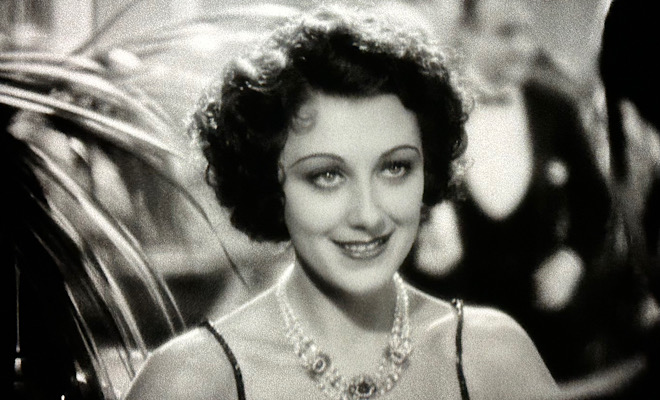
Dvorak's wild, fiery eyes light up every scene in which she appears, but she's at her best in the thrilling finale when Cesca emerges from the shadows brandishing both an ice-cold stare and a loaded handgun. It's one of the film's most striking images and stands as a chilling contrast to the steamy sexuality Dvorak exudes during most of the movie. Sadly, Scarface didn't catapult her to stardom the way it did Muni and Raft, though she certainly deserved it. Dvorak signed a long-term contract with Warner Bros after the film's premiere and was subsequently wasted in a barrage of B films that eventually killed her career.
Raft doesn't do much other than flip coins, a bit of business Hawks devised to make the inexperienced actor feel more comfortable in front of the camera (Billy Wilder would memorably spoof it 27 years later in Some Like It Hot), and though it's fun to see Karloff out of monster makeup, he's a tad too dignified (and way too British) to play a Chicago gangster. Surprisingly, the film's best supporting performance comes from arguably its least known performer, Osgood Perkins, who's perhaps best remembered as the father of Norman Bates...I mean, Anthony Perkins. The elder Perkins was an accomplished stage actor who only made a scant 20 films before his untimely death from a heart attack in 1937 at age 45, but he brings wonderful dimension and authenticity to the slimy Lovo.
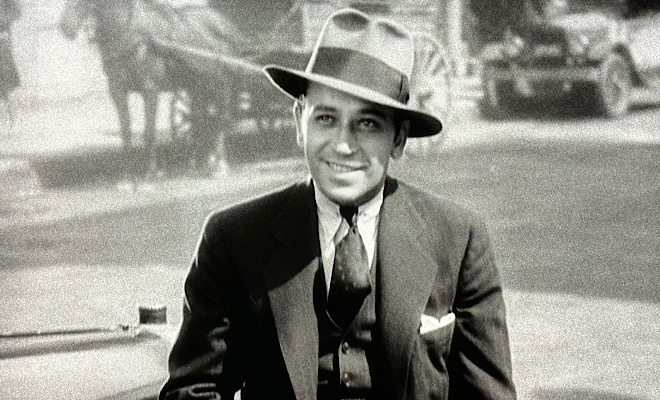
Say what you will about Howard Hughes, but at the tender age of 26 he produced the quintessential gangster movie. That's quite an achievement, and it grows ever more impressive as the years tick by. Gangster films come and go, but Scarface sticks around because it captures the essence of an era as it was transpiring. The ripped-from-the-headlines story somehow still feels fresh, and the messages about crime, morality, and most importantly, gun violence (who cares if the censors mandated them!) remain relevant and relatable almost a century later.
Strip all that away, and you still have a ferociously entertaining and impeccably filmed crime drama that brims with excitement, sex, violence, humor, and vivid, hot-blooded characters. De Palma pays homage to this all-time classic, but his lavish, bloated, over-the-top remake can't beat Hawks' lean, mean, gritty original. Little Caesar and The Public Enemy drew up the gangster blueprint, but Scarface broke the mold...or rather shattered it in a flurry of bullets.
Vital Disc Stats: The 4K Ultra HD Blu-ray
The 1932 version of Scarface arrives on 4K UHD packaged in a standard Criterion case. A 12-page booklet featuring an essay by film historian Imogen Sara Smith, transfer notes, and a cast and crew listing is tucked inside the front cover. A 1080p Blu-ray disc is also included in the package. Video codec is 2160p/HEVC H.265 and audio is uncompressed mono. Once the disc is inserted into the player, the static menu without music immediately pops up; no previews or promos precede it.
Video Review
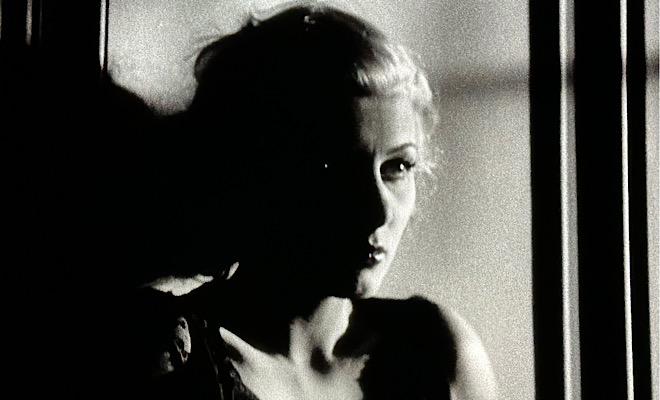
According to the liner notes, "This new 4K restoration was created from a 35 mm duplicate negative." The 2160p/HEVC H.265 transfer is not enhanced with HDR or Dolby Vision, so it lacks the extra pop those technologies provide. The native 4K picture nevertheless exudes plenty of vibrancy, despite a prevailing softness that's surely baked into the source. A fair amount of grain is present - the heightened texture is typical of early 1930s films - but the presentation is very film-like and faithfully honors the cinematography of Lee Garmes, who won an Oscar the very same year for Shanghai Express, and L. William O'Connell. Clarity and contrast are quite good, but the moments of true 4K splendor are sporadic. Blacks are rich, shadow delineation is excellent, whites are crisp, and a pleasing grayscale brings out fine details and enhances depth. Sharp close-ups showcase sweat droplets, the omnipresent scar on Muni's face, and Dvorak's wild, dark eyes. Crush is largely absent, and no nicks, dirt, or scratches mar the pristine print.
The 1080p Blu-ray disc included in the set looks mighty fine as well, though it lacks the level of detail and clean lines that distinguish its 4K UHD counterpart. The softness that's evident on the 4K presentation is amplified here, but not to an alarming degree. I could detect no palpable differences between the Criterion Blu-ray and the 2021 Imprint Films Blu-ray release, so if you own the Imprint edition and aren't interested in 4K, there's no reason to purchase the Criterion Blu-ray. The 4K transfer is certainly a step up from both Blu-rays, but the improvements aren't substantial enough to merit an upgrade unless you're a megafan.
Audio Review
A 35 mm nitrate composite fine-grain was the source for the remastered original monaural soundtrack. Scarface has always had audio issues due to the primitive recording equipment used at the time and this uncompressed track occasionally amplifies them. Hawks creatively used the sound to pump up the viscerality of the shootouts and this track really delivers in that regard. The gunfire is loud, crisp, and pulse-pounding and there are palpable bass rumblings in a key explosion. Screaming sirens are appropriately shrill, the crackling of shattering glass is distinct, and subtleties like soft whistling make an eerie impression. The sporadic incidental music sounds a bit thin, but that's to be expected.
Sadly, the dialogue can be difficult to comprehend at times. Part of that has to do with Muni's mumbling and thick accent, but when verbal exchanges have to compete with effects or characters talk over one another the track becomes a tad cacophonous. Silences are clean, however, and any age-related defects have been erased.
Special Features

Except for the alternate ending, none of the extras from the Imprint Films Blu-ray or Universal Blu-ray have been ported over to this Criterion release, so if those are important to you, you'll want to hang onto those discs. The spate of Criterion supplements is surprisingly slim for such an important motion picture, but the content is well produced. All the special features reside on the Blu-ray disc.
-
Alternate Ending (HD, 11 minutes) - The alternate ending doesn't really begin until the final three minutes of this segment, but the entire final shootout is included to better set up the sequence and heighten its impact. Hughes agreed to supply a new ending to satisfy the censors, but Hawks balked at the changes and refused to shoot it. (Second unit director Richard Rosson directed it instead.) By this time, Muni had left Hollywood and was appearing in a Broadway play, so he was unavailable, which explains his absence from the footage. In many ways, the alternate ending, though quite preachy, is more powerful and grisly - and far less glamorous - than the original's go-out-in-a-hail-of-bullets finale. It certainly hammers home the message that crime doesn't pay, which of course is the whole point, is stylishly shot, and blends in well with the rest of the movie, but the original ending is preferable.
-
Conversation with author Megan Abbott and actor Bill Hader (HD, 37 minutes) - The author and Saturday Night Live alum chat casually about the gangster genre, Muni's genius, the film's incestuous subtext, Hawks' freewheeling directorial style, the alternate ending, the strong female characters, how the movie influenced Martin Scorsese, and other topics. Clips from the movie illustrate their talking points, but there's a little too much giggling for my taste in this overlong, often rambling discussion.
-
Interview with film scholar Lea Jacobs (HD, 17 minutes) - The professor-emeritus at the University of Wisconsin-Madison examines Hawks' use of sound in Scarface. Jacobs talks about how Hawks favored "short, punchy scenes" to minimize dialogue while seeking to match the rhythm of verbal exchanges to the intensity of the visual action to create the proper narrative pace. Jacobs also references Hawks' screwball comedy Twentieth Century to further illustrate her points.
Final Thoughts
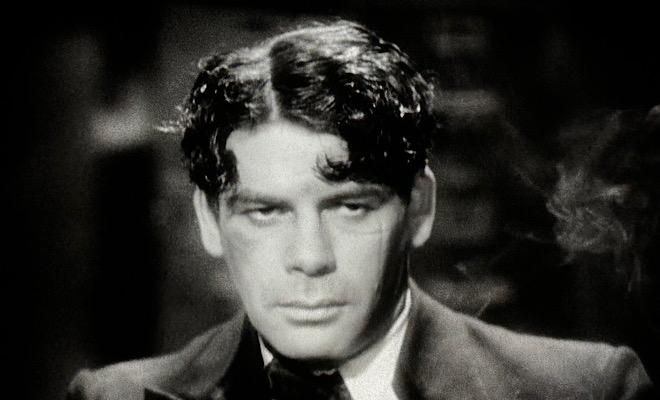
You can have Brian De Palma and Al Pacino. I'll take the Howard Hawks and Paul Muni version of Scarface any day of the week. Tight, nasty, sexy, and violent, this explosive pre-Code gangster film memorably chronicles the rise and inevitable fall of a ruthless Chicago crime boss modeled after Al Capone. Criterion's 4K UHD release doesn't possess the wow factor, but it's a faithful rendering of this prized antique and a modest improvement over previous Blu-rays. If you're a fan, it's worth the upgrade, but keep your Blu-ray(s) for the extras. Highly Recommended.
-
 Turbine Gasses Up For Texas Chainsaw Massacre 4K UHD Mediabook Legendary BundleBy:
 -
 Strange Bedfellows: Why Horror is a Natural Fit for 4K UHD & Blu-ray Physical MediaBy:
 -
 Turbine Is Back In Action for John Watts’ ‘Clown’ on 4KUHD Mediabook November 13th!By:
 -
 The Horror of 'Clown in a Cornfield' Comes Home With A 4K UHD SteelBook from RLJE Sept. 9th!By: