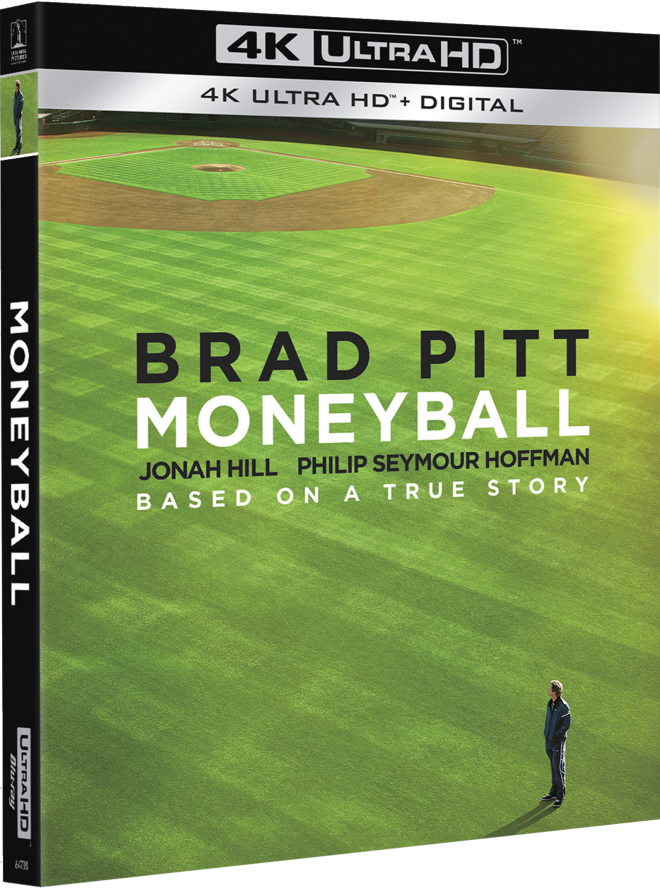
Moneyball - 4K Ultra HD Blu-ray
After fifteen years, Bennett Miller’s Moneyball steps up to the plate on 4K UHD from Sony. One of the best films of the 2010s, the film remains an understated sports drama with terrific performances from Brad Pitt, Jonah Hill, and Philip Seymour Hoffman. On 4K SDR, the image is terrific with the same excellent audio and solid lineup of archival bonus features to prop up this release. Highly Recommended
Click to Order:

Storyline: Our Reviewer's Take
Because our old friend Nate Boss already did a fantastic write-up of this film, I’m going to largely let his words stand. But for my two cents' worth, I loved Moneyball. It’s wild that it’s been fifteen years, but here we are. Watching this new 4K release, it struck me that this has become something of an annual spring-time rewatch as the MLB season kicks off. As a former yute third baseman, I have an endless love for the game - even if I’m not as engrossed in it like I used to be. I’m also a Detroit fan, so that comes with some fickle enthusiasm. But at its heart, this film is a love letter for the magic of the game.
The season can go either way. You could have the perfect roster and end up with the worst string of losses. You can have the best team the game has likely ever seen - but never crack a World Series win. You could even have the worst roster that no one in sports believes in, and end up tying the record for the longest streak of wins in the history of the game. It’s on that note that I find my love for Moneyball.
I remember the A’s 20-game streak, going from a division laughing stock to an organization that could possibly win it all was a hell of a summer for baseball. The film isn’t about an underdog player or a has-been; it’s not even about an entire team of “misfit toys” and losers that came together and became winners. Moneyball is about Billy Beane (Brad Pitt), who changed the game using a controversial statistical methodology so the forgotten “could-haves,” like he once was, had a chance to prove themselves out on the diamond. Of course, the sport never remains pure, as we’ve seen over the last two decades. Stats - valid or completely useless - now dominate the sport. The jaded baseball fan in me writes this off as a means for pudgy dipwits in suits to have something to bitch about on SportsCenter while even pudgier fans have something else to bet on beyond batting averages and run spreads.
But as a film about how this course change was implemented, Moneyball is a hell of a feature, and a romantic tribute to our national pastime of rooting for the underdogs. Again, I’m a Detroit fan, and we’re currently 7-9 as of this writing. I keep bringing up Detroit in part because in 2006, we swept Beane’s A’s in the ALCS to head for the World Series…where we then promptly lost it in five to the Cardinals for the World Series. It’s a hell of a game! Crazy stuff happens all the time. We can turn this around and have a winning season… only for our roster to be gutted again after the summer, and we’ll be back at square one, rebuilding the team all over again.
Now here’s what Nate had to say oh so many years ago:
Do you remember the days when baseball players were judged by somewhat simple statistics? How hitting a bundle of home runs and batting in teammates was enough to land you in the All Star Game, or even put you in the Hall of Fame if you were able to compile gaudy numbers? Or even how pitchers could earn big paydays by being the winning pitcher consistently or putting up solid win-loss numbers? The days when the back of a baseball card told you a lot about a player's worth are long gone, as the game has evolved in the last decade. Newfandangled statistics are cropping up almost yearly. Fielding range, OBPS (on base plus slugging), or my personal least favorite, WAR (wins above replacement) have been adopted by baseball think tanks, both for the major league organizations and the media covering them.
The simplicity is long gone. At the same time, the emotion is gone, too. I used to enjoy reading articles comparing the stars of today to those of yesterday, imagining a Babe Ruth or a Ty Cobb in the modern era. Now, said stories are impossible to read, as the writers let these stupid analytical tools take the heart out of the column, and we're left with wishy-washy "arguments" and, dare I say, half-assed "facts" that have turned something fun into a chore to read. And it all started in the early 21st century, when a horrible ballplayer turned general manager for the Oakland Athletics had to change the way his small market franchise was playing.
Writer Michael Lewis wrote the book Moneyball: The Art of Winning an Unfair Game, as he followed Billy Beane's 2002 attempts to replace three departed stars that his team could not afford to lose and still maintain competitiveness. This season changed the game forever, as Beane took the mantra espoused by Bill James (the founder of sabermetrics, the advanced baseball analytical toolset) to find value in players where other teams only saw risk. When the team was extremely successful during the season, other teams took notice, and suddenly players who hit for low averages but got on base regardless became gems instead of outcasts.
The Bennett Miller-directed film adaptation of this influential book has everything working against it. This is not your traditional baseball movie. We're not following a team destined to win it all. We're not even following a team that has won it all since the system in place was implemented. Rather, the career of Beane (Brad Pitt) is chronicled, from the tumultuous 2001-2002 offseason, to the growing pains of implementing a radical new approach, with accents of Beane's playing days thrown in as a reminder of how many "five tool" players don't pan out. As the GM battles fruitlessly with ownership to get the funds necessary to be competitive on the field, the team eventually clicks, and soon magic starts to happen. The end result, all sports fans know, and some of us can't forget the record breaking winning streak the team went on. 'Moneyball' looks past the manager (Phillip Seymour Hoffman) of the team, past its players (particularly Chris Pratt as Scott Hatteberg, Stephen Bishop as David Justice, and Casey Bond as Chad Bradford), and into the mind, heart, and soul of one of the first GM's to make news for reasons other than his hiring or firing, along with his assistant Peter Brand (Jonah Hill) who clued him in to this new baseball mindset.
Not everyone will enjoy 'Moneyball,' and I get that. This film has so much more in common with David Fincher's 'The Social Network' and its take on Facebook than, say, 'Field of Dreams'or '61*,' so naturally those looking for a "pure" sports movie need look elsewhere. This flick captures the book's essence, including the controversial aspects, such as the portrayal of manager Howe (which he wrote off as incorrect and biased), and manages to make a film about managing a sport, rather than playing it, as fascinating and dramatic as any other flick in the genre. The thing about 'Moneyball,' though, isn't just the way it shows a changing mentality, a burgeoning thought process, but also the way it represents the old guard, the traditional system reliant on seasoned scouts and teams bidding on players like they were mercenaries. The early scenes in the film with the old think tank say it all: there are two ways to approach a problem, one by filling a gap by throwing money at it at established stars and names, the other by thinking outside the box, untraditionally, abandoning the old way of thinking, as it doesn't quite work when you aren't given the money needed to accomplish it.
Brad Pitt may look nothing like Beane, but he does a damn good job portraying the man, while the film itself also does wonders in capturing the failed player. Over the years I've read a number of write ups about the controversial GM, and the one that stood out the most was the fact that he didn't really watch the team he crafted, and cared more for soccer than the game that made him famous. While this other passion isn't touched upon, the crafty, slightly dubious approach to handling players and other teams is realized quite nicely. The real surprise, though, is the fact that Hoffman, an established acting star and scene stealer if ever there were one, is outshone by the portly Hill, whose previous credits gave no indication he was capable of a buttoned down, serious role, and the kid nails it.
'Moneyball' has a score of tongue-in-cheek humorous moments, plenty of intrigue, and a very non-traditional structure in crafting a film about sports (rather than a sports film) that doesn't feature a single player who will reach the Hall of Fame. It doesn't even really mention the fact that the team sported the American League MVP or Cy Young winner, as they're seen but never heard or mentioned. It properly reflects the romanticism of the game, and addresses that as we see the ups and downs of a season and their toll on the man who crafted the experiment. If nothing else, 'Moneyball' will stand as a tribute to a man who changed the sport, for better or worse, and does so with one simple line in the film, one that I can't help but repeat:
"You did good, Billy. We're really proud of you."
Vital Disc Stats: The 4K Ultra HD Blu-ray
Moneyball upgrades its stats to 2160p 4K UHD with a new single-disc release from Sony. Pressed on a BD100 disc, the disc is housed in a standard black case with digtial slip. Artwork for the case reflects the art we’ve seen on past discs for the last 15 years. The slipcover replicates the teaser theatrical posters. The disc loads to a static image main menu with standard navigation options, with the bonus features listed along the left side of the screen. NOTE - apologies for the lack of images, I haven't been able to rip this disc as of yet. When I can, I hope to swing back and add in full 4K-sourced images.
Video Review
Pinch-hitting to 2160p SDR, Moneyball on 4K disc without an HDR grade is probably best described as an in-the-park homerun. This transfer was reportedly approved by director Bennett Miller, and I have to give credit where it's due; it's a beauty. I’ve only ever had the original Blu-ray release from 2012. I never did buy the “Mastered In 4K” set Sony offered in 2013 because I just didn’t see the point, so I can’t compare that disc. However, from the original 1080p to 2160p, this is a notable upgrade in my book. The higher bitrate yields some impressive, life-like details and an intense sense of depth and dimension. Film grain remains natural and cinematic throughout without appearing overly noisy or intrusive. It might be blasphemous to some to say this part out loud, but I don’t always think an HDR grade is necessary. Upgrading the resolution and moving the image into a wider color gamut, you’re going to see an immediate improvement in overall quality. Flipping between my 14-year-old Blu-ray and this new 4K disc, that wasn’t much of a contest. Skin tones are healthy and human-looking. Primaries are lovely and well-saturated. Whites are crisp and bright without blooming. Black levels are deep and inky without crush. Wally Pfister shot a hell of a good-looking picture, and this 4K disc delivers the goods.
Audio Review
On the audio front, we have what sounds like the same dynamic DTS-HD MA 5.1 mix - which is just fine to me. There’s not a lot about this film where I feel like an Atmos remix would have been all that beneficial. So much of the movie’s magic and auditory excitement comes from the crackling Steven Zaillian and Aaron Sorkin dialog exchanges. An Atmos mix probably wouldn’t move the needle any and would be a wasted effort. There’s still plenty of surround channel activity, but it’s all subtle and unintrusive while making us feel like we're in the A's scrappy locker rooms. We feel like we’re in the pit of the A’s offices, not out in the stands of crowded fans. To that end, the dialog is crystal clear and without issue. The excellent Mychael Danna score is a lovely accompaniment to the drama on screen, without ever overpowering the soundscape. All around, a great mix of the film.
Special Features
On the whole of things, this is a decent assortment of extra features, but as a 15th Anniversary release, I’m a little let down. What we have here is essentially a repackage of previous extras from the 2011 disc, now with the theatrical trailer. I would have loved to see a retrospective of some kind with the cast and crew, or even a sit-down with Beane, if for no other reason than the game has changed so much since the A’s historic run in 2002. But as is, this disc more or less completes the package, where the “Mastered In 4K” set didn’t offer any extra features.
- Deleted Scenes (HD 12:05)
- Brad Loses It Bloopers (HD 3:11)
- Billy Beane: Re-Inventing the Game (HD 16:02)
- Drafting the Team (HD 20:51)
- Moneyball: Playing the Game (HD 19:28)
- Adapting Moneyball (HD 16:33)
- Theatrical Trailer
Moneyball is a hell of a film. I understand why it could be nominated for six Oscars and not win any. 2012 was a competitive year. But, awards or no, it’s remained a favorite film. It’s not even one I fell in love with right away. It was only in the last few years that I noticed that I’d pull it off the shelf seemingly right around the time the new MLB season would kick off. Brad Pitt delivers one of his best performances in a relatively unglamorous role, while Jonah Hill is a true standout in a subdued supporting position. Not that I needed a reason to watch Moneyball again, but a new 15th Anniversary 4K set certainly qualifies. The new 2160p SDR transfer is lovely, proving that even without HDR, you can still score a homerun of a transfer - I find no serious reason to fault it. The same great audio mix returns, and we also see the return of the same extra features package. I’d have liked to see some genuine NEW extras for this set, but that’s my lone gripe. Love the film, love the transfer. It might not be something everyone needs to upgrade to, but if you’re buying for the first time, it’s a great disc. Highly Recommended
Click to Order:
-
 Turbine Gasses Up For Texas Chainsaw Massacre 4K UHD Mediabook Legendary BundleBy:
 -
 Strange Bedfellows: Why Horror is a Natural Fit for 4K UHD & Blu-ray Physical MediaBy:
 -
 Turbine Is Back In Action for John Watts’ ‘Clown’ on 4KUHD Mediabook November 13th!By:
 -
 The Horror of 'Clown in a Cornfield' Comes Home With A 4K UHD SteelBook from RLJE Sept. 9th!By: