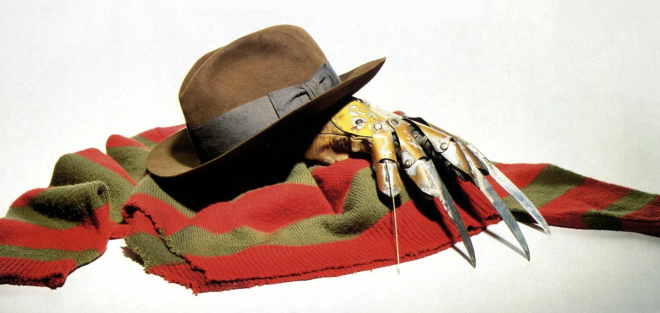
A Nightmare on Elm Street 7-Film - 4K UHD Collection
With only a handful of notable figures surviving the 80s slasher boom as lasting icons of the genre, Freddy Krueger is one such horror legend that has left a major impact and continues to be just as entertaining as when it originally premiered, leaving behind a cultural legacy and several comical yet fun sequels. Entering the dreams of Ultra HD, Warner Home Video and New Line Cinema unleash A Nightmare on Elm Street: 7-Film Collection with beautifully remastered HDR10 videos and highly satisfying Dolby Atmos soundtracks. Although supplements are the same as before, the overall UHD package is worth the purchase and Highly Recommended.
Storyline: Our Reviewer's Take
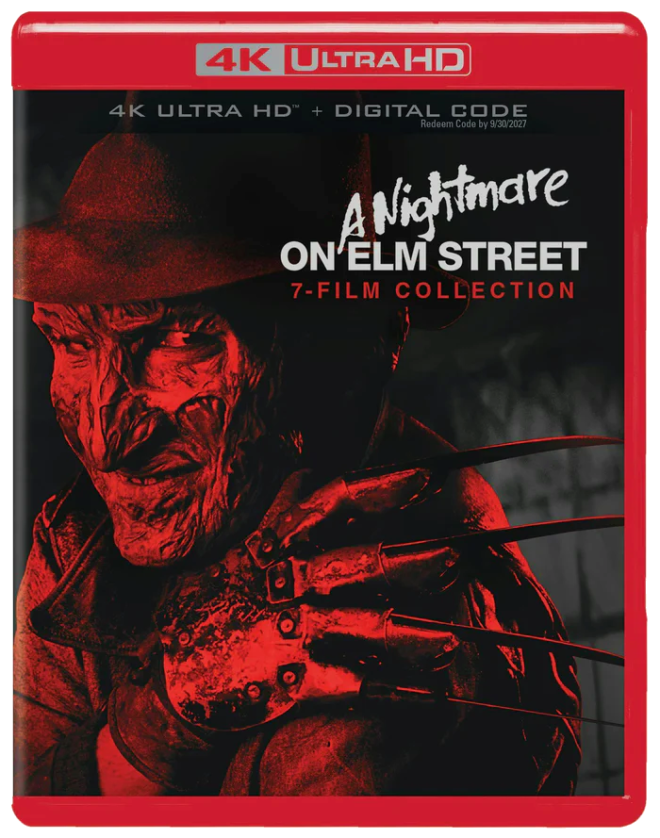
A Nightmare on Elm Street
Growing up, few horror movies made me behave like such a scaredy-cat, and along with Michael Myers and the demon Pazuzu of The Exorcist, the vengeful ghost of a child murderer terrorizing the dreams of kids on Elm Street made me cower in fear of the boogeyman. As if his backstory weren't enough to creep out most viewers, his appearance is one that simply seeps into our memory banks and resides there permanently. Just as Tina (Amanda Wyss) and Nancy (Heather Langenkamp) found his image disturbing, the thought of a man with a burnt face wearing a grimy fedora hat and a torn red and green striped sweater hiding in the shadows is pretty unsettling. Added to that, the weirdo also likes to make loud screeching sounds and has a hideously sinister laugh.
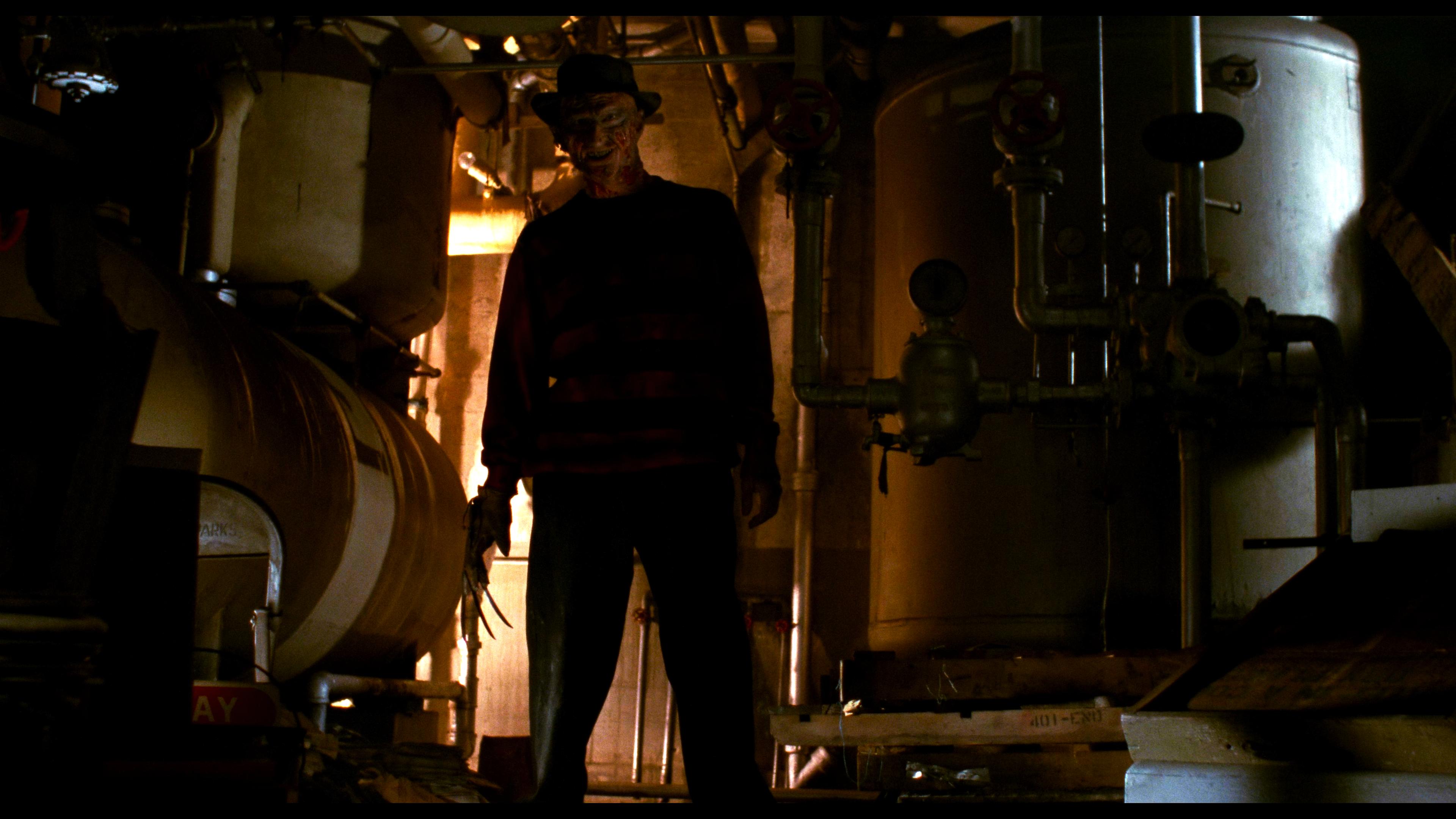
Of course watching the movie today, it doesn't exactly draw the same kind of reaction, but that may have more to do with the countless number of times it's been watched and not directly related to any faults within the film. A Nightmare on Elm Street still possesses a certain eeriness to it, which makes it fun to watch, and holds a great sense of nostalgia for a time when such flicks were original and fresh. Director Wes Craven cemented his name as a master of horror and has since become recognized as a legendary filmmaker for originating one of the most iconic characters in the genre, right up there with Dracula and Frankenstein. And if not for the absolutely one-of-a-kind performance by Robert Englund, Freddy Krueger would not be the household name it is today.
While the successes of Carpenter's Halloween and Cunningham's Friday the 13th arguably opened the doors for Craven's vision to be realized, Nightmare stood as a unique and terrifying revelation to the latest cliché-ridden craze sweeping low-budget horror: sexually promiscuous teens meet their demise in savagely gory fashion. Eventually spawning a franchise loved by many, the original not only used many of the same characteristics as previous movies but also expanded upon them by taking the dark, brooding psychopath into the one place we normally feel the safest. Our dreams. Equipped with a basis in reality and several other inspirations, Craven's Nightmare also features some interesting elements that make it stand out among others in the subgenre, revealing a smart and clever horror film.
A Nightmare on Elm Street introduced a supernatural element to the slasher formula with the killer stalking his adolescent victims in their nightmares, making it difficult for them, and the audience, to distinguish between dreams and reality. Rather than simply being a large, bulking mass of lunatic rage, Freddy brazenly toys with his prey and speaks to them with malicious and diabolical mockery. Nightmare also shows weak relationships between parent and child, presenting teenagers from dysfunctional families. The film, moreover, takes the "Final Girl" epithet a step further in the Nancy character. Adding to the idea of being sexually unavailable, Nancy ups the ante by being skillfully resourceful and a clever survivalist. For me, these subtexts add to the film's appreciation and really make Craven's horror classic worth more than its violent, gory parts. (Movie Rating: 4.5/5)
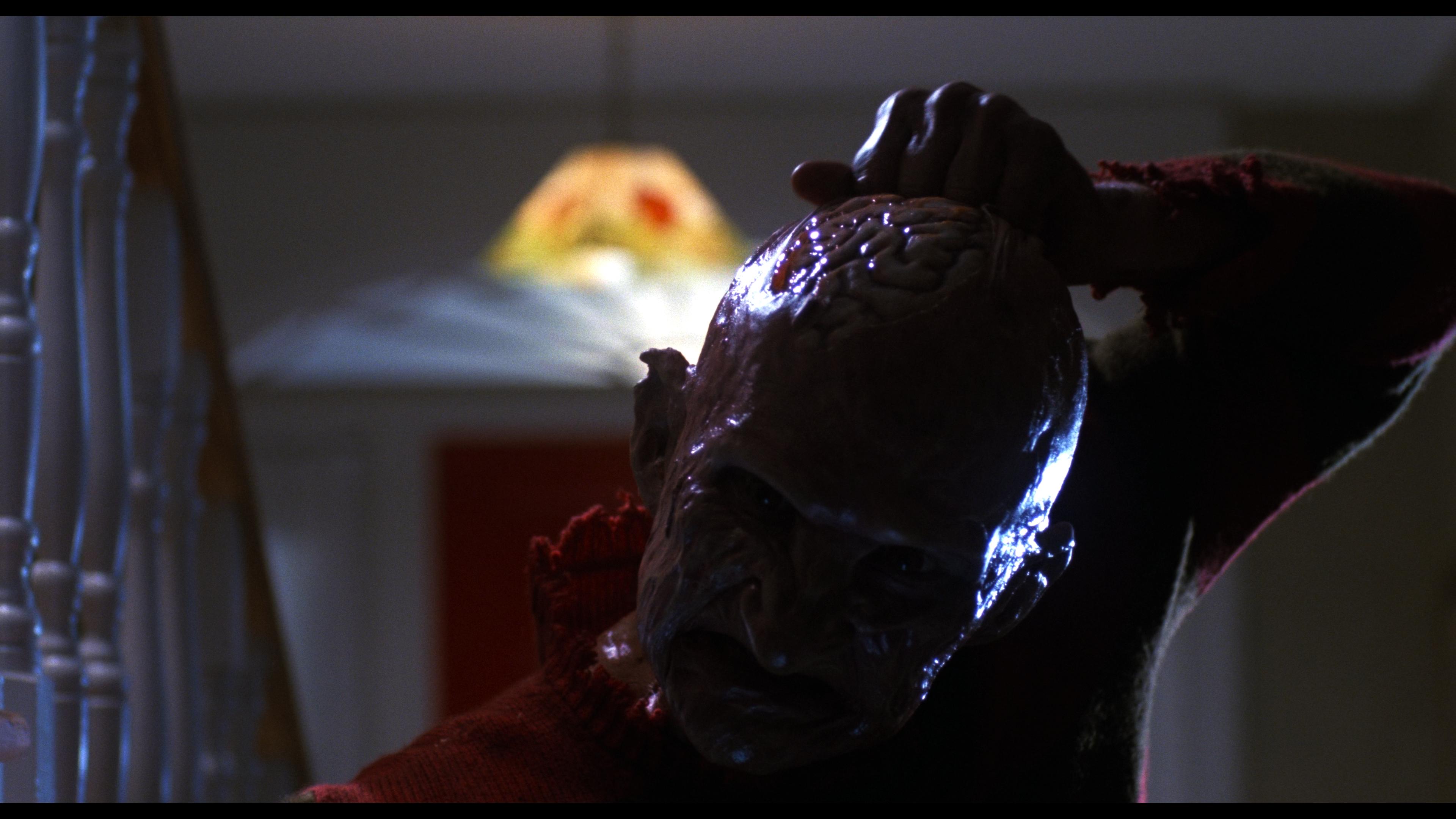
Freddy's Revenge
After the immense success of Craven's Nightmare, New Line exec Robert Shaye took advantage of its commercial appeal with this poorly conceived follow-up. In fact, this is the one movie of the entire franchise seen by many, including its own creators, as the best-forgotten stain on Freddy's history. Part of the problem is the attempt to stray from Craven's clear guidelines of the Freddy Krueger mythos, something that later installments try to correct. Working from a script by newcomer David Chaskin, director Jack Sholder proudly brought the killer out of the dream world and into reality, taking it even further by involving a possession/psychological element that ultimately seems silly. Nevertheless, there are a few aspects worth appreciating in this sequel.
One of them, which evolves into the franchise's signature trademark, is Freddy's god complex and his witty, cynical one-liners just before killing his victims. None of it is quite as blatant or meant to be wholly humorous as others in the series, but we can see the makings of a beloved and celebrated horror icon in this sequel. His interactions with Jesse (Mark Patton) are a bit comical and twisted, though Sholder's direction maintains a certain level of spookiness throughout. Freddy also displays a playful, maniacal side in his reign of terror, enjoying the many ways he toys with his victims. Unfortunately, much of this seems defeated in a script that drags in several places with conversations questioning Jesse's mental health. Too much about Jesse and not enough time spent with Freddy.
Another troubling aspect of Freddy's Revenge is the removal of a central female protagonist. On the surface, it seems like a silly notion to gripe about, but as this movie proves, watching one's dream violated by a child murderer is more terrifyingly effective with a character like Nancy. With Jesse, the story carries an underlying implication of homoeroticism and a teen struggling with sexual identity. Much of this goes in line with the plot's psychological element, and one prominent scene shows Jesse unable to be affectionate with Lisa (Kim Myers). The whole affair simply takes away from the movie's fear factor and is worsened by the idea that Nancy's former house contains the ghost of Freddy Krueger. In the end, the sequel is really the least memorable of the Nightmare franchise yet carries some clever subtext worth appreciating. (Movie Rating: 2.5/5)
Dream Warriors
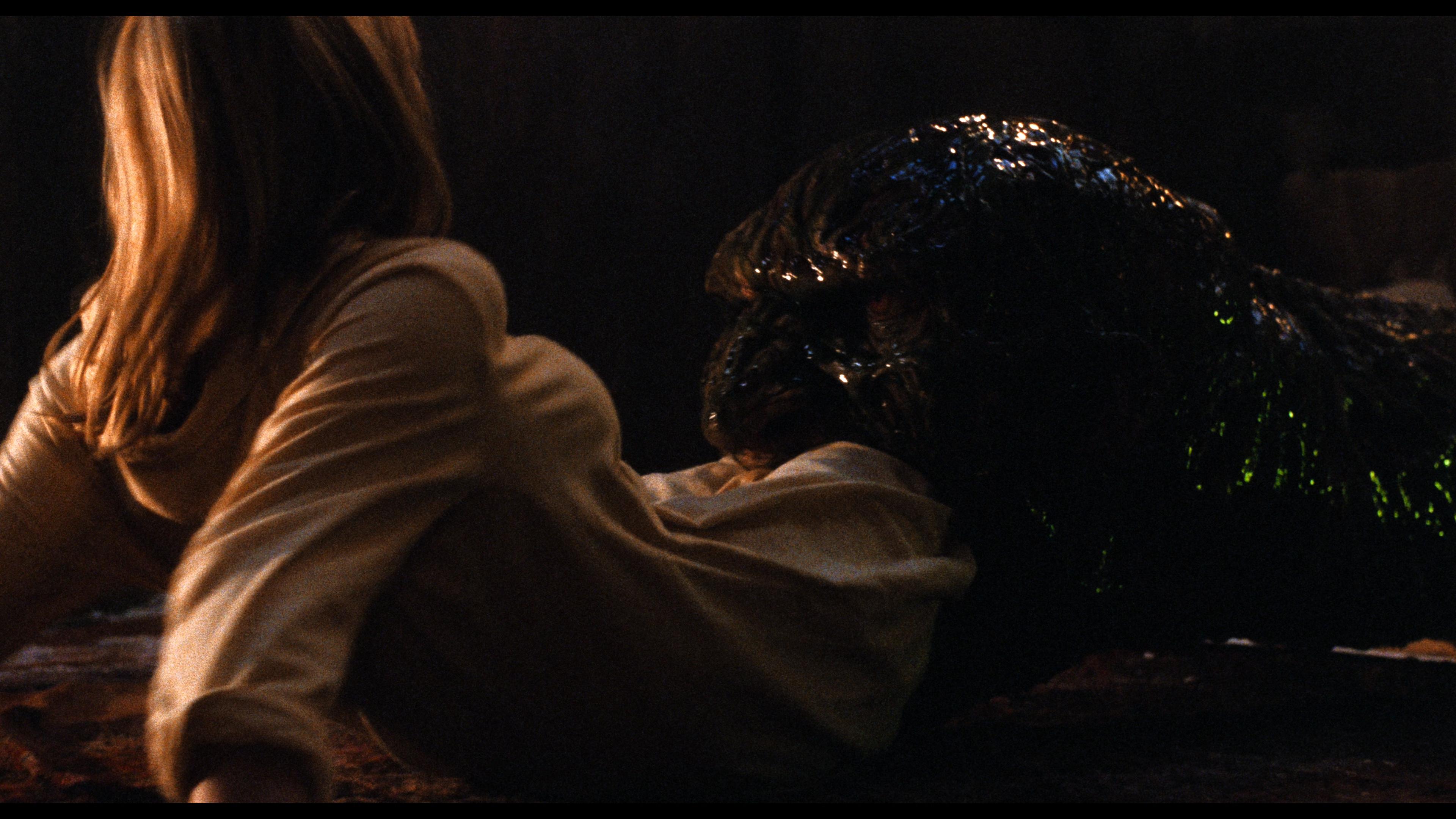
Things drastically improve with the third installment, which brings back the franchise's creator, Wes Craven, to write a screenplay that makes better use of Freddy's mastery over the dream world. The previous movie never really took advantage of this concept and its imaginative possibilities, so from its opening moments Craven's story seems determined to do precisely that. It also features a central female character in a very young Patricia Arquette as Kristen, and like Nancy, the teen has a distant relationship with her mother that coincides with a sleeping disorder. However, those issues are lightly glossed over in favor of what fans really want. Right from the start, Dream Warriors makes itself known as a slasher horror flick about nightmares with Freddy at the center of it all.
It's easy to gather that Craven aimed for the second sequel to be the franchise's return to its origins and make the last entry a forgotten dream. Freddy doesn't just haunt one kid but chases after a group of teens fearing the one place where they should feel safest. Upping the ante, the kids are a troubled motley of psychiatric patients with highly active imaginations, allowing for director Chuck Russell to be wonderfully creative with each nightmare sequence. This is where Freddy's warped sense of humor is solidified, showing that he enjoys taunting his victims in ingenious and often hilariously ironic ways. And Englund loves every minute of it. With this in place, Dream Warriors also takes a moment to give Freddy a bit more history and background, revealing he's "the bastard son of a hundred maniacs."
Craven's story idea, which was later tightened a bit more by Frank Darabont (The Walking Dead, The Shawshank Redemption) in one of his earliest industry jobs, makes a further connection to the first movie by having the kids be "the last of the Elm Street children." It's a bit of a stretch to be sure but nicely rectified with Heather Langenkamp reprising her role as Nancy Thompson, now working as a therapist and sleep specialist. Demonstrating Freddy's power to control the dreams of others doesn't hurt either. Nonetheless, it's all part of a master plan as fans watch Nancy's father (John Saxon) and her coworker (Craig Wasson) try to locate Freddy's remains in an auto salvage yard. Basically, Craven intended to bring any possibility of a franchise to a screeching halt, but fortunately for us horror maniacs, that attempt quickly failed. (Movie Rating: 4/5)
The Dream Master
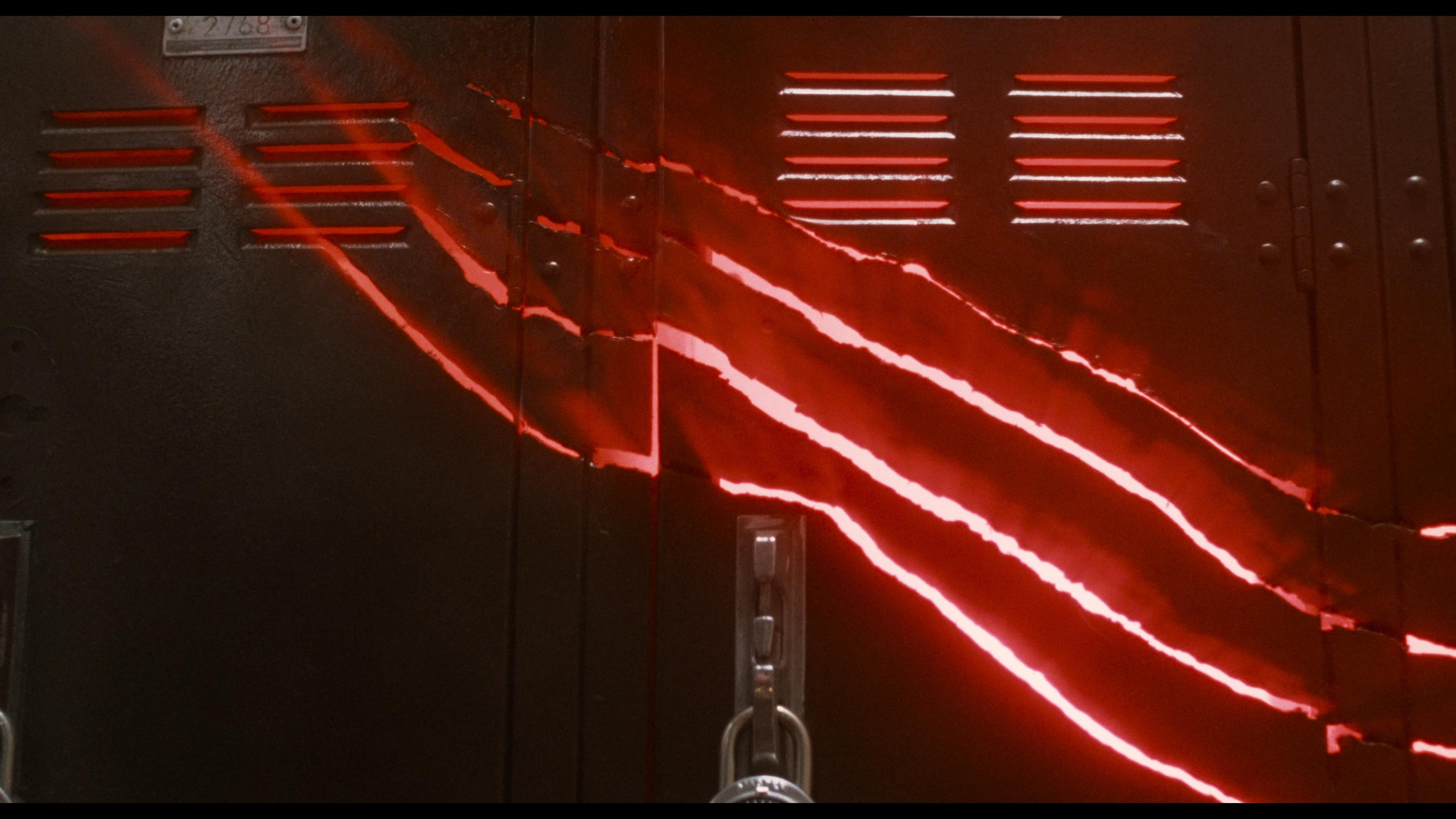
I still remember walking out of the theater after watching Dream Warriors thinking that was the end of Freddy Krueger. How could filmmakers possibly resurrect the infamous child murderer with the finger knives after that conclusion? However, when part four was released, I quickly learned that anything is possible in Tinseltown, no matter how ridiculous. And the way in which the makers of Dream Master bring Freddy back is incredibly stupid though still pretty hilarious (a dog's fiery urine is apparently the spark of life he needed). Interestingly, it sets the movie's tone as something that doesn't take itself seriously, as in part two, and the plot establishes a clear departure from Craven's original concept in an ingenious manner that works surprisingly well.
The plot takes place soon after the events of the previous movie. The last of the Elm Street kids, Kincaid (Ken Sagoes), Joey (Rodney Eastman) and Kristen (now played by Tuesday Knight), return for Freddy to finally complete his revenge. But not until after Kristen shares her unique ability with her shy, daydreaming friend, Alice (Lisa Wilcox), which is where we find the real genius of the story. The script by Brian Helgeland (L.A. Confidential, Mystic River, Man on Fire) and the Wheat brothers (Pitch Black, The Fly II) has our iconic villain's thirst for taunting teens extend beyond the Elm Street neighborhood. Through Alice, Freddy's legend grows so that other kids fear and bring him into their dreams. Essentially, the movie has the makings of an ongoing franchise.
And like the third entry, the movie explores the highly inventive potential of seeing nightmares come alive. A yet-unknown at the time, Renny Harlin (Cutthroat Island, The Long Kiss Goodnight) directs with a cartoonish delight, carefully balancing the scares and the laughs without feeling terribly silly or goofball. In fact, his strengths as a filmmaker are seen during the dream sequences as each kid meets their demise by confronting personal fears and phobias. Of all the Nightmare flicks, Dream Master has some of the craziest and most memorable special effects with Freddy's death being a highlight that continues to astound. Admittedly, the movie comes with many drawbacks, namely the amateur acting, but it's fun and amusing nonetheless. (Movie Rating: 3/5)
The Dream Child
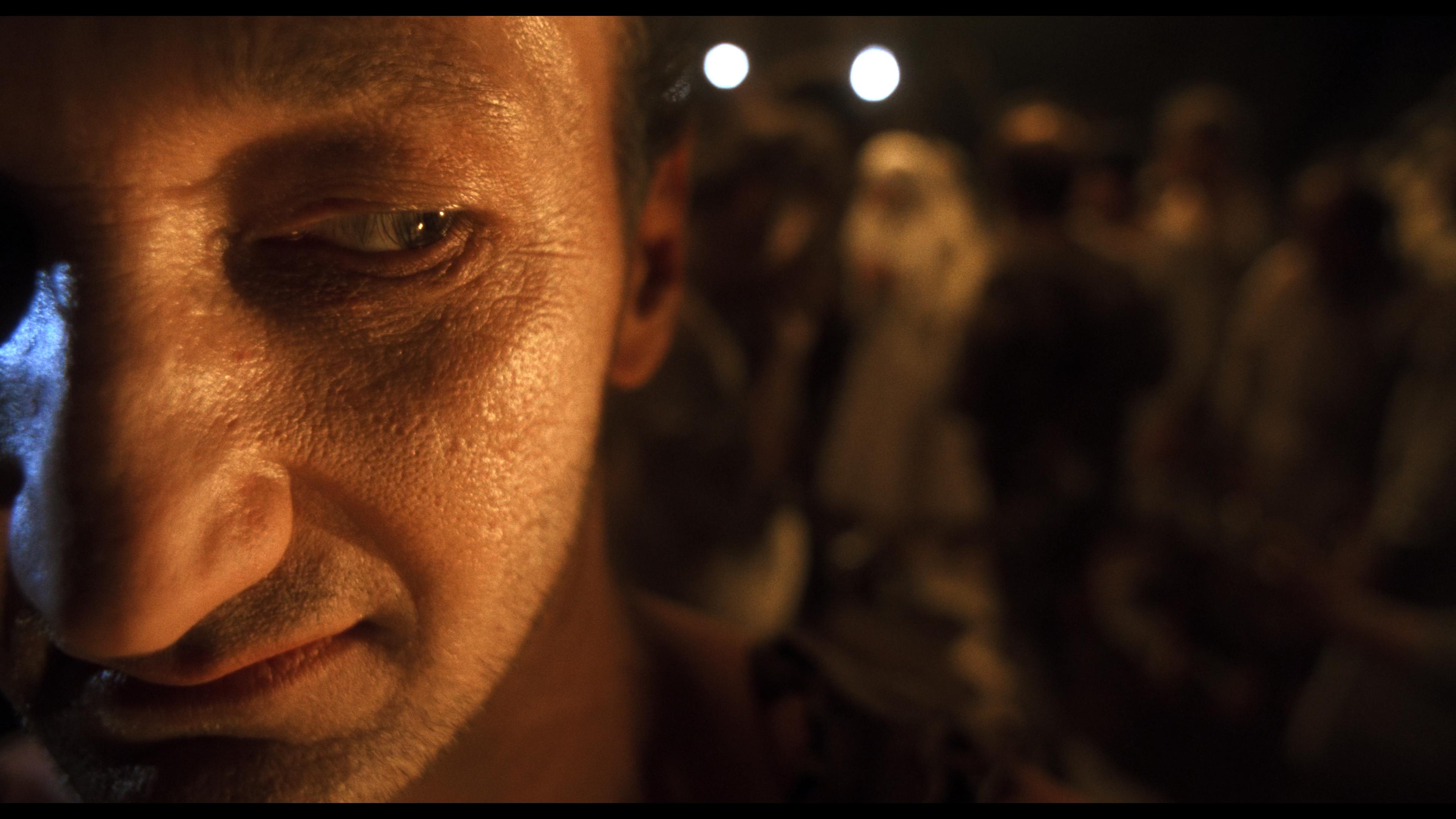
After the spectacular finale of the previous movie, it's difficult to imagine how Freddy could ever return or have a comeback as equally fantastic. But this fifth installment tries to do just that, opening with one of the most bizarre birthing scenes imaginable. A mix of flashback and nightmare, audiences are made to witness Krueger's birth at the infirmary of the insane asylum and looking like the demon prune from hell with an oversized head. After crawling to a dilapidated chapel conveniently engulfed in shadows, Freddy howls from growing pains and quickly fills into his iconic outfit with the fedora and gloves. The whole event is laughably excessive but weirdly fitting for the Nightmare universe. Sadly, the rest of the movie fails to live up to this absurdly sensational beginning.
Lisa Wilcox returns as Alice and unwittingly becomes responsible for Freddy being reborn and haunting the dreams of her new friends: Yvonne (Kelly Jo Minter), Mark (Joe Seely) and Greta (Erika Anderson). Following the continuity of the two movies that came before it, she and her boyfriend Dan (Danny Hassel) move on with their lives as recently graduated high school sweethearts. We don't learn of the particulars behind Freddy's mysterious resurgence until much later, only after a wacky but somewhat creative death scene involving a literal speed demon. As far-fetched and dim-witted as it may seem, we have to give the three screenwriters responsible for this silliness some credit for at least developing this one original plot device. However, the teen pregnancy angle opens some pointless melodrama as well and ultimately goes nowhere except for more bad acting.
Director Stephen Hopkins, who later moved on to helm The Ghost and the Darkness and Lost in Space, does what he can with the material, which is really nothing more than goofball fun. He doesn't make an attempt at being taken seriously (aware of the sort of movie he's making) and goes with it to a certain degree. And Dream Child is all the better for it. How could any filmmaker sell the comic-book fight or the M.C. Escher-inspired final showdown with complete earnestness? But at the same time, it's also the movie's downside, coming across more as a comedy than horror and further transforming the Freddy persona into a perverse prankster. The visual fatuousness and overall zaniness of the movie are about the only saving grace, and the laughs make it tolerably watchable. (Movie Rating: 2.5/5)
Freddy's Dead: The Final Nightmare
By the time we reach the sixth entry (and the formally last in the series' continuity), filmmakers seem conscious of the franchise's clownish faults but embrace it nonetheless as the circus-like freak show it had become. As with her predecessor, director Rachel Talalay, who also served as producer of parts three and four and later helmed the wacky dystopian Tank Girl, makes the best of the eccentrically gonzo direction Freddy had taken and further exploits the character's comedic side. Freddy is now a sadistic mischief-maker who toys with his victims in some questionably stupid, roll-your-eyes moments. (The pothead, videogame sequence takes the cake for one of the worst deaths.) But sadly, the best intentions are not enough to save this entry beyond being amusingly bad.
Freddy's Dead also features some of the worst acting of the entire franchise, which, when compared to the other movies that came before it, means it's pretty dreadful. Leading the pack, unfortunately, is Lisa Zane as Maggie, a therapist working with troubled teenagers. As the plot's main attraction, carrying a secret with close ties to the Krueger saga, her role is rather vital, but Zane appears as if only half-committed and completely bored. Conversely, Shon Greenblatt and Lezlie Deane, as John and Tracy, can't seem to contain their enthusiasm for taking part in a Freddy movie, delivering their lines with unconvincing, histrionic elation. The only two actors with any seriousness to their performances are Yaphet Kotto (Alien) and Robert Englund, with the latter showing a great deal of fun.
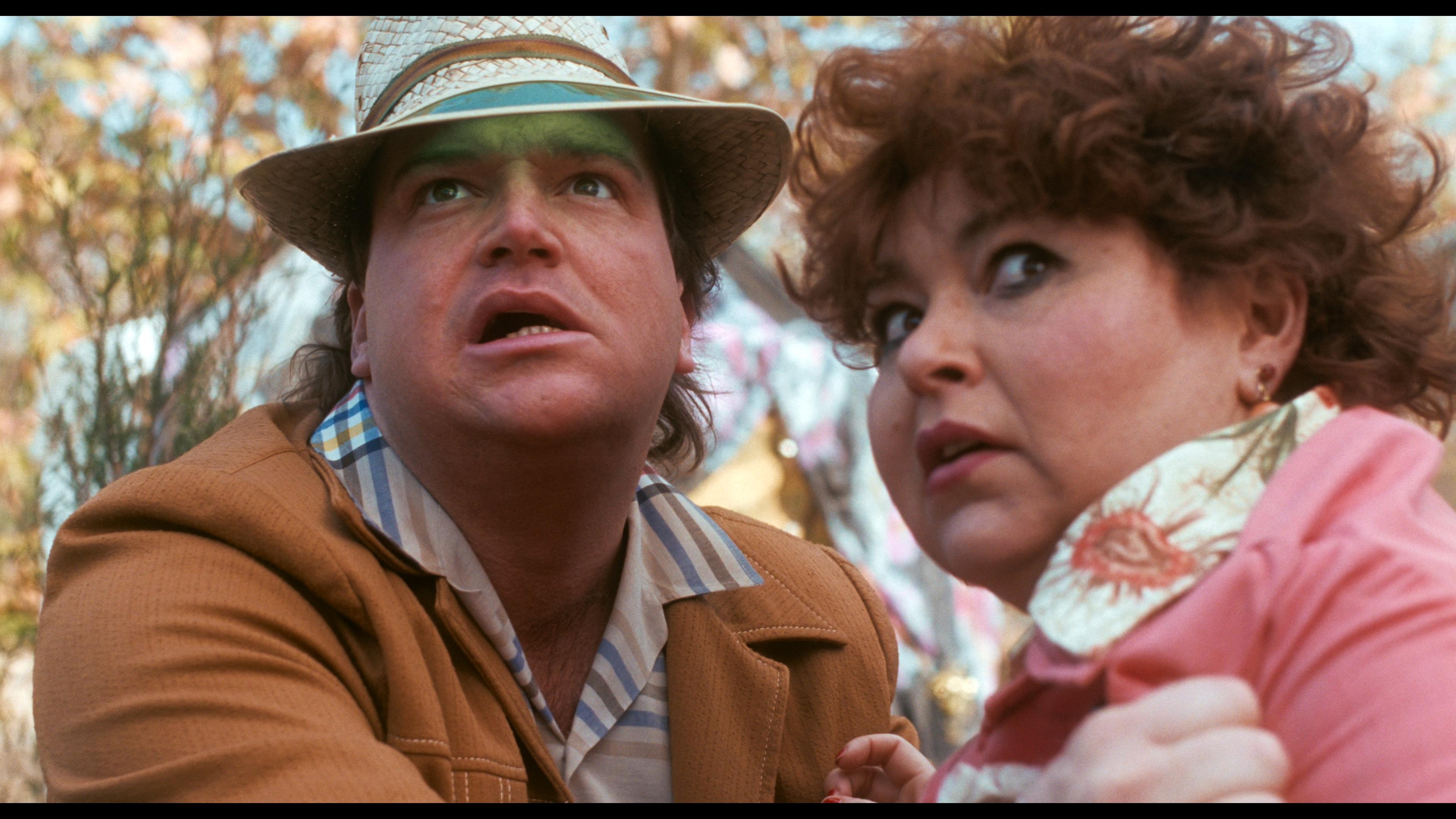
On a positive note, the movie does add to the Freddy mythos and expands a little on the character's life prior to invading the nightmares of teens. Although the very brief explanation of the Dream Demons is a bunch of cockamamie nonsense, Talalay's story, which was scripted by producer Michael De Luca (In the Mouth of Madness), reminds fans that the celebrated horror icon is a child-murdering monster, allowing us a sneak peek into his repulsive secret room in the basement. Unfortunately, the possibilities within the plot feel wasted in this sixth installment and degraded further with a conclusion that's nowhere near satisfying, let alone even respectful to Freddy Krueger's legacy. Cameo appearances by Johnny Depp, Roseanne Barr, Tom Arnold, and Alice Cooper insert some amusing humor, but the movie is only worth watching to see those small tidbits into Freddy's past. (Movie Rating: 2.5/5)
Wes Craven's New Nightmare
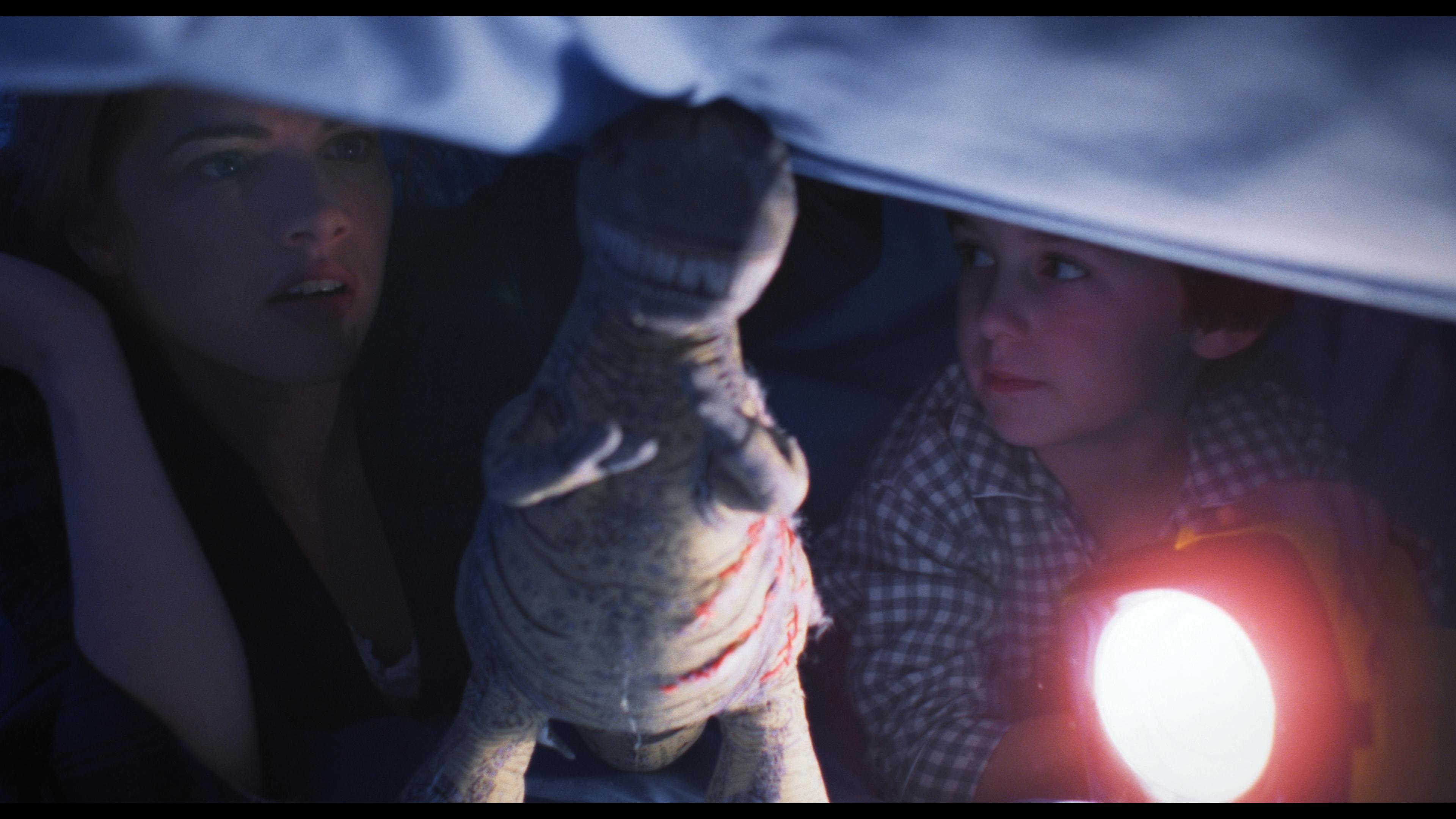
After the disappointing finish of the last movie, it's no wonder its creator, Wes Craven, returned to his beloved character with a decidedly unflattering look at what had become of him. The story goes that franchise producer Robert Shaye asked the horror director his opinion about the film series and Freddy's demise. Out of the frank conversation came a need for one final entry that would give the celebrated horror icon a proper farewell. Craven also set out to eliminate Freddy's comically cartoonish demeanor from previous movies and restore his frightening image as a perverse psychopath who invaded the dreams of his victims. The result is one of the best and smartest installments of the franchise since the original, and interestingly serves as a precursor to the similarly themed Scream series.
As the title suggests, the film aims to stand out as something distinct from the rest of the franchise while also celebrating the aspects that made the original memorable and enjoyable. For this, Craven returned to the initial premise he conceived for Dream Warriors, a light but ultimately silly examination on the origin of scary stories. Most clever, however, is the concept's amusing attempt at breaking the fourth wall, where viewers are essentially watching the making of a Freddy movie as it is being written by its creator. Or better yet, as it is being dreamt up. Craven does a far better job at bringing the character into the real world than Jack Sholder's sequel, and much of that is due to an understated dissatisfaction with the franchise. It's almost as if Freddy is angry with the way he'd been portrayed over the years and intends to reaffirm his position as a villain worth fearing.
Freddy's victims this time around are not teens who believe him to be only an urban legend, but rather the filmmakers facing more true-to-life horrors and nightmares. Many involved in the first film return as themselves, with Heather Lagenkamp leading the way, slowly realizing her dreams become strenuously difficult to distinguish from reality. Events in the last quarter, melding with those from part one, are particularly amusing and smartly brought to fruition. Freddy, himself, receives a scarier makeover to differentiate him from the others, and it works well for this dark reimagining. A couple of aspects of the script, however, slow things down, like Lagenkamp and Craven's conversation, and some optical effects look terribly dated. But all in all, New Nightmare is true to Craven's vision and makes a great conclusion to a much-loved horror franchise. (Movie Rating: 3.5/5)
Vital Disc Stats: The Ultra HD Blu-ray
A Nightmare on Elm Street 7-Film - 4K UHD Collection comes courtesy of Warner Home Video/New Line Cinema with a digital code, unlocking all seven movies, including the two uncut versions, in 4K Dolby Vision HDR and Dolby Atmos audio. All seven films are granted their own dedicated Region Free disc with the first six stamped on dual-layered UHD66 discs while New Nightmare is allowed a triple-layered UHD100 disc. They are all housed together on individual trays that flip over inside a dark red, keepcase with one themed pair of red-blue anaglyph 3D glasses.
The package also arrives with a red and black cardboard slipcover featuring Freddy Krueger and his infamous glove. At startup, the discs go straight to a static menu screen as music plays in the background. The first and fifth movies give viewers the option to select the theatrical version or the unrated cut, which is just a few deleted seconds of additional gore and violence that don't add anything to the story.
Video Review
A Nightmare on Elm Street
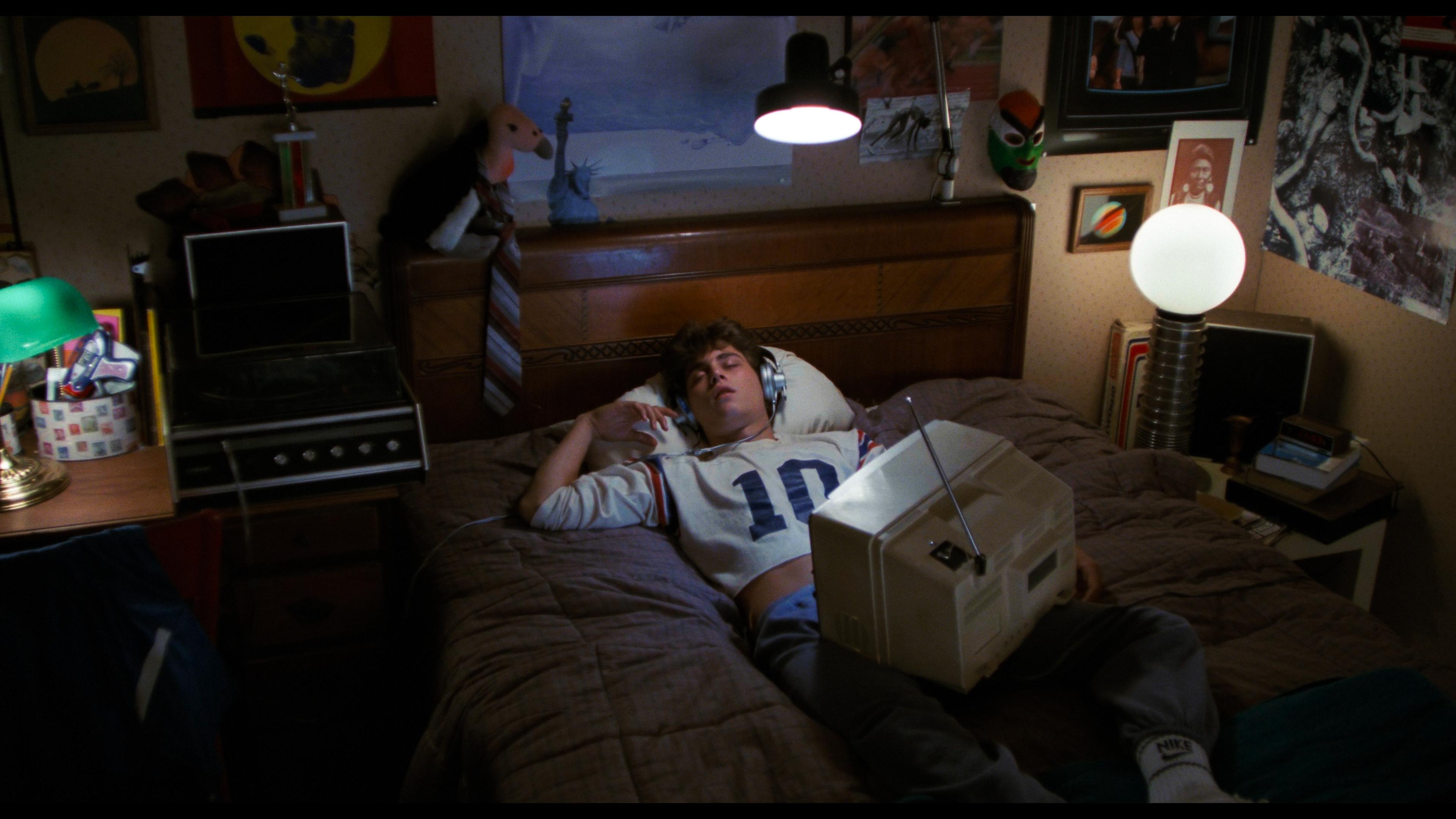
The transfer appears to be identical to the previous 4K release. Here are my thoughts from that review:
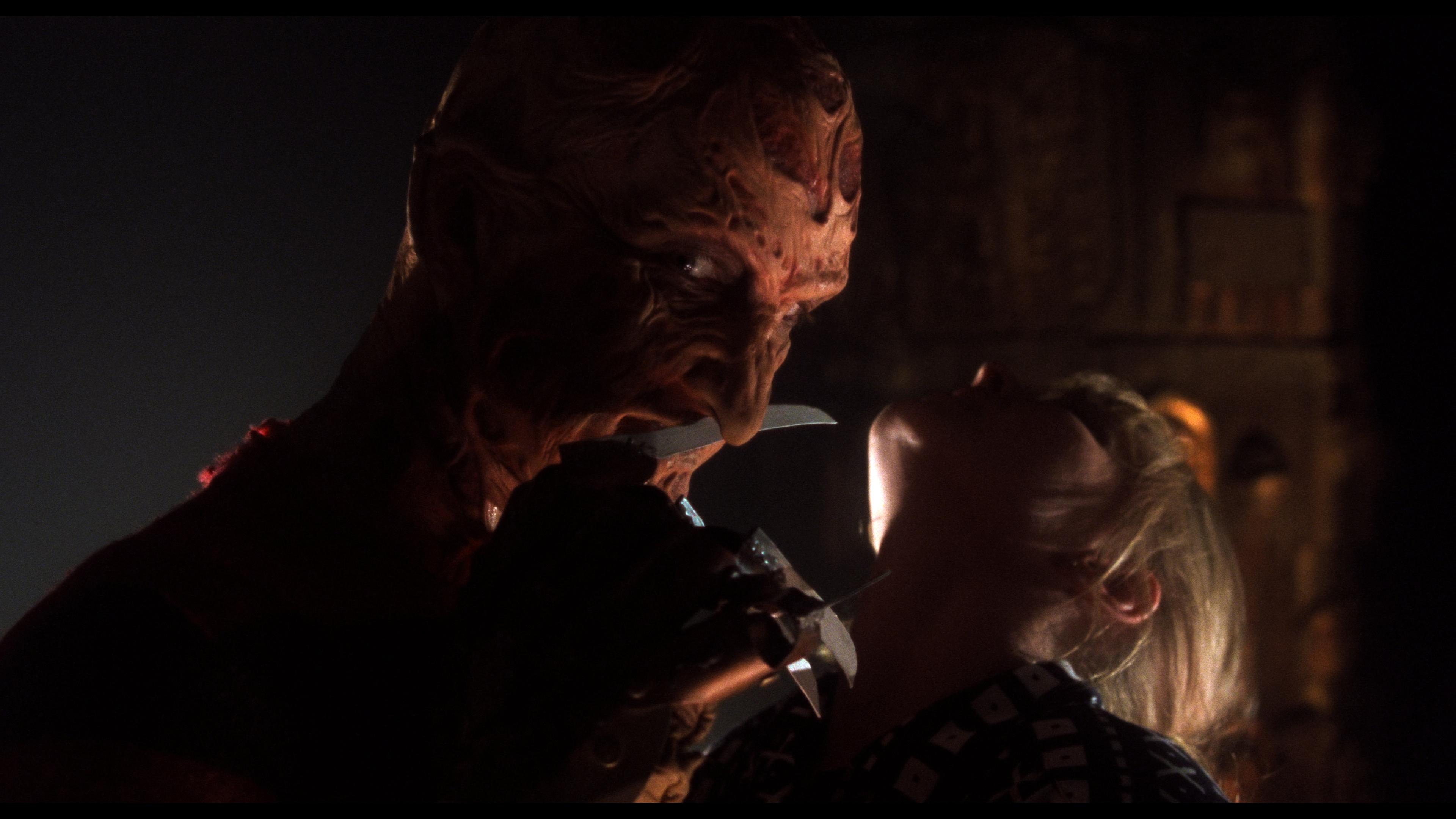
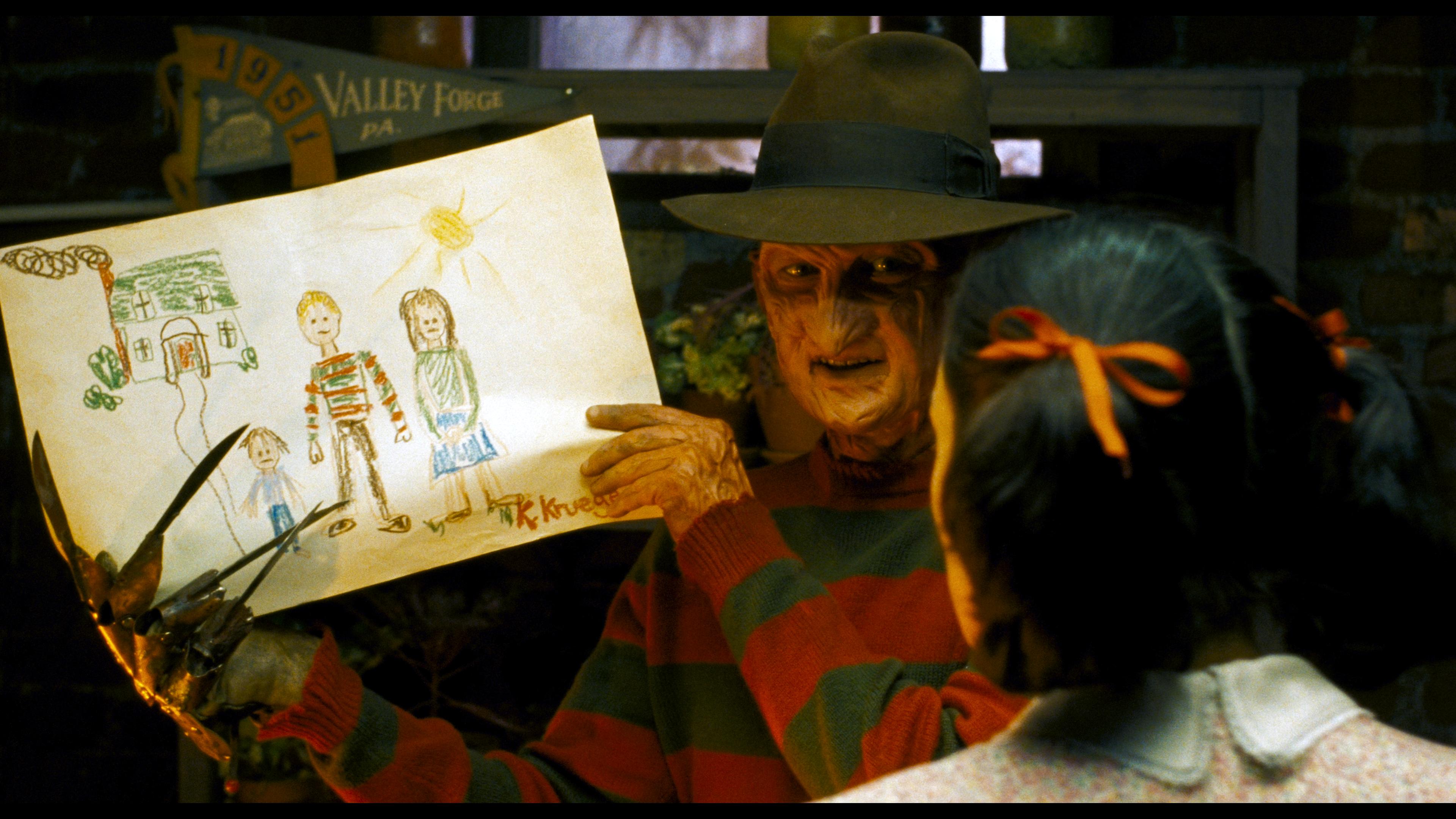
"Freddy chases the kids of Elm Street on Ultra HD with a surprisingly beautiful-looking HEVC H.265 encode for both cuts of the film, offering a notable upgrade from previous Blu-ray releases. Reportedly coming from a fresh remaster of the original elements, the native 4K transfer arrives with sharper details, from the distinct hairs of the actors and the fabric of sweaters to the various features of Nancy's house and Freddy's burn scars. A couple of scenes, here and there, are somewhat dated as expected, mostly noticeable in the fade transitions, but overall, the image is amazingly well-defined with better visibility of the smaller objects in the background.
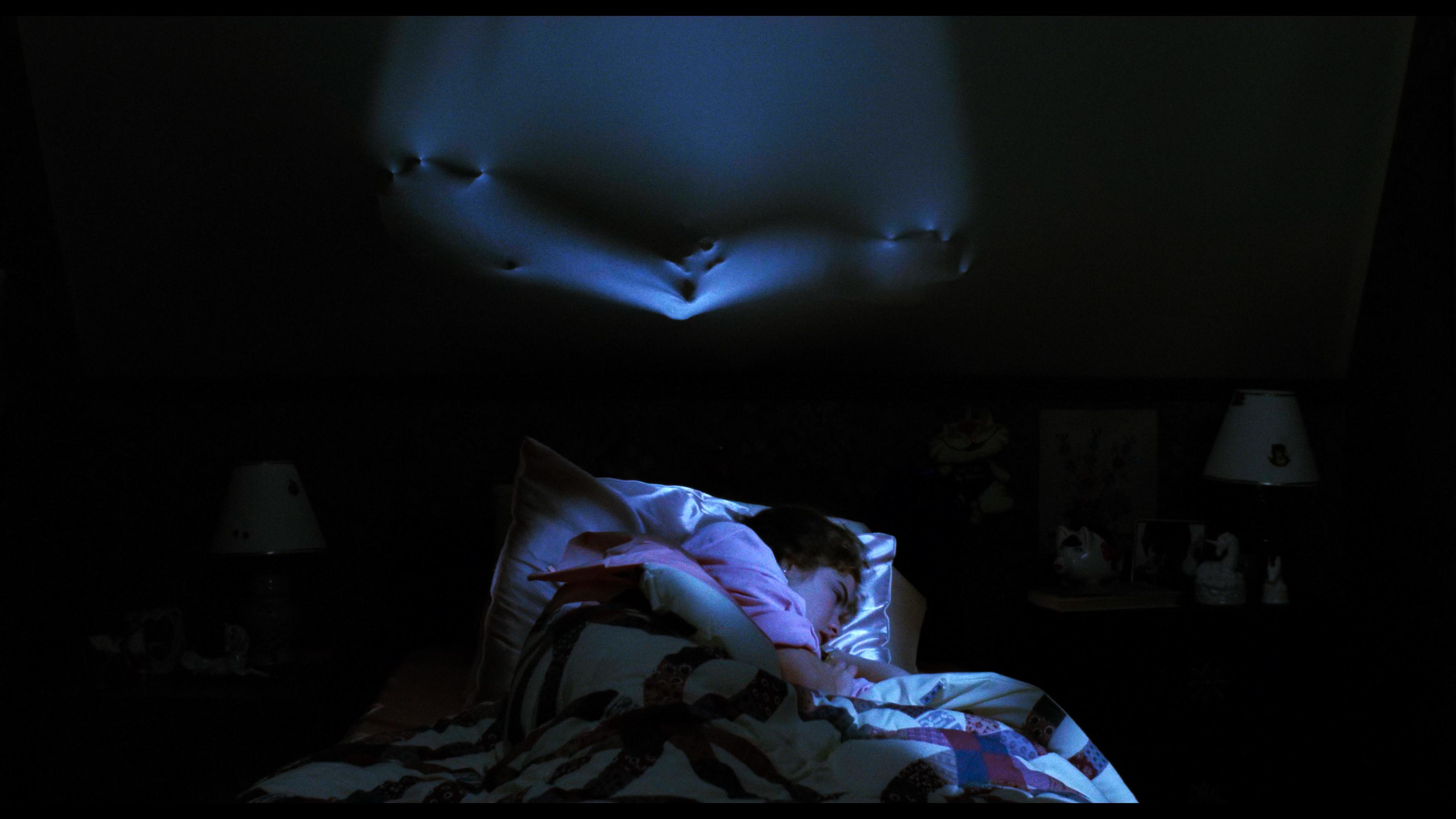
"The HDR10 presentation also displays an impressive, spot-on contrast and brightness balance, rejuvenating the 40-year-old movie with intensely brilliant, immaculate whites and crisp, luminous specular highlights. Nighttime sequences are swimming in inky rich blacks and darkly ominous midnight shadows that never obscure the finer details, providing the 1.85:1 image appreciable depth and an attractive cinematic appeal. Arguably, the most striking aspect of the video is the sumptuous arrays of colors, like the full-bodied steely blues of the night scenes and the highly animated reds to the vividly dynamic secondary hues, such as the various shades of pink of the outfits. Best of all is seeing the green stripes of Freddy's sweater in the many dark scenes and the healthy, peachy-red complexions of the cast, exposing pores, the tiniest freckles and negligible blemishes.
"Showered in a thin, more refined layer of natural grain, the entire 4K presentation delivers an outstanding improvement, making this the definitive version of the Wes Craven horror classic." (HDR10 Video Rating: 92/100)
Freddy's Revenge
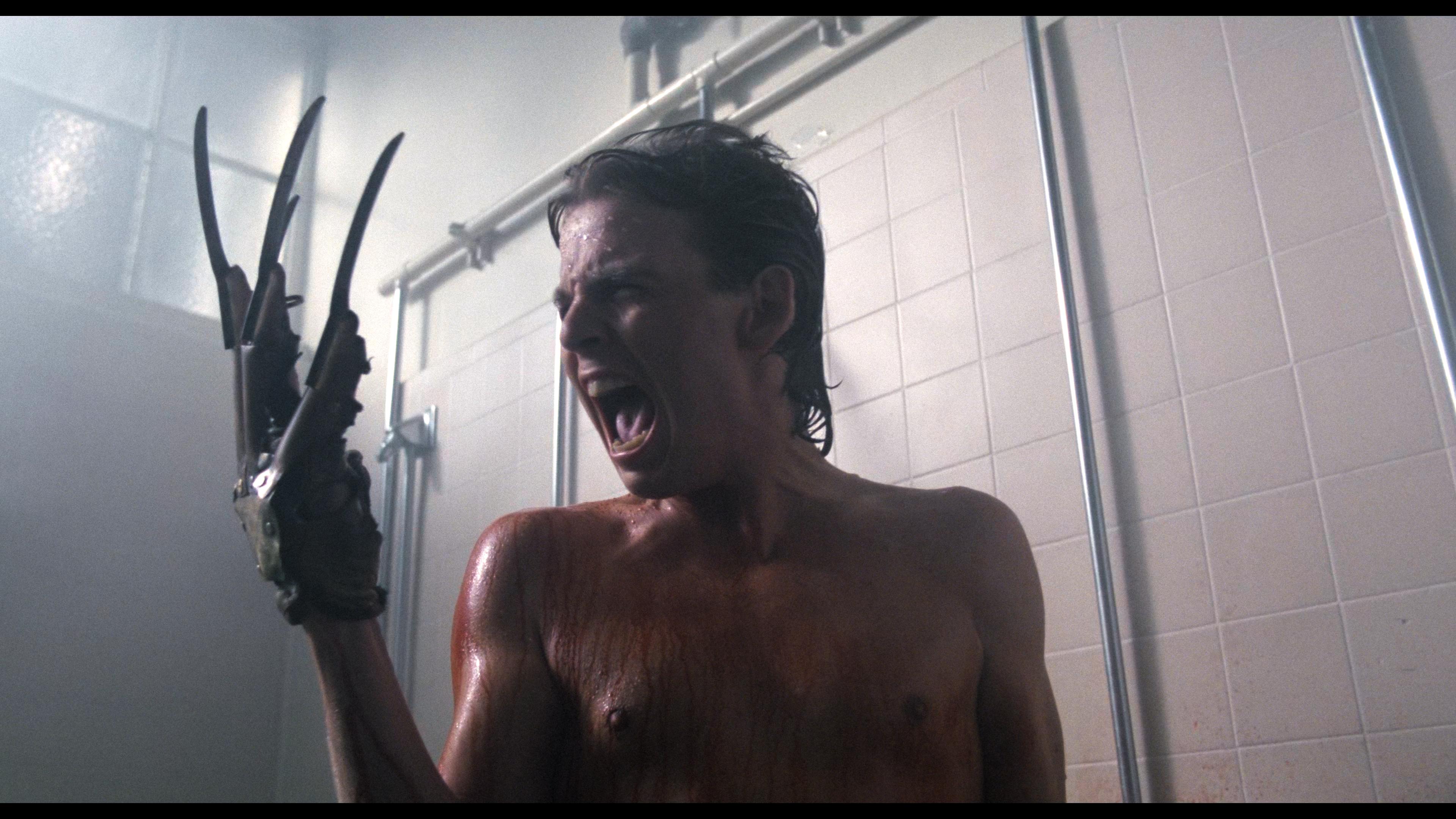
Freddy takes out his revenge on Ultra HD with an excellent HEVC H.265 encode, which was reportedly sourced from a new remaster of the original elements. The native 4K transfer is clean and highly detailed for a majority of the runtime, except for a few softer, blurrier moments that are inherent to the source and due to the original photography. The biggest boost is the spot-on contrast and brightness balance, bathing scenes in inky-rich blacks and vibrant specular highlights while the 1.85:1 image maintains strong visibility within the darkest shadows and hottest spots. Likewise, colors really pop and appear fuller with healthy skin tones in the entire cast. Overall, the sequel comes home with a beautiful HDR10 presentation. (HDR10 Video Rating: 90/100)
Dream Warriors
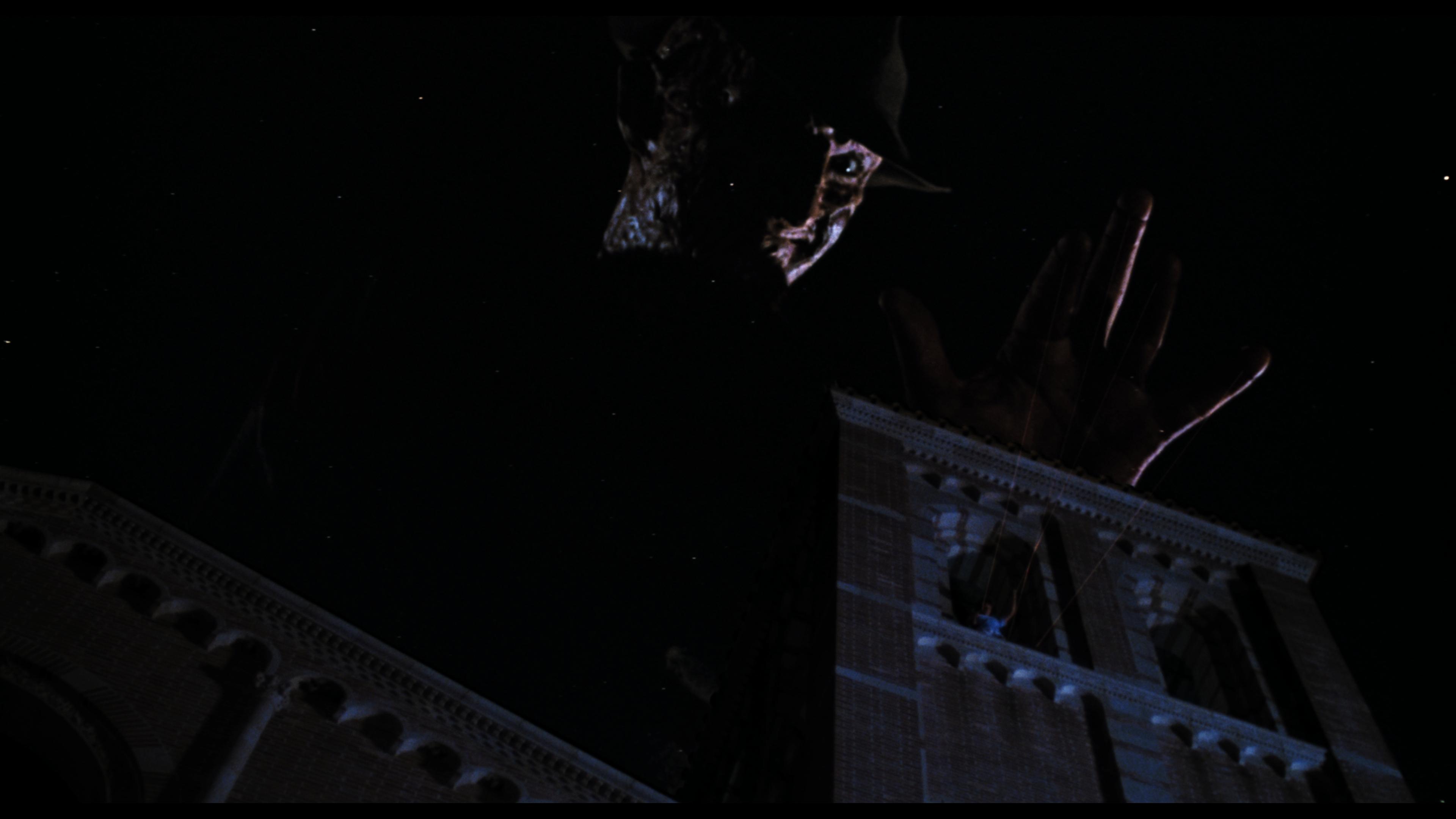
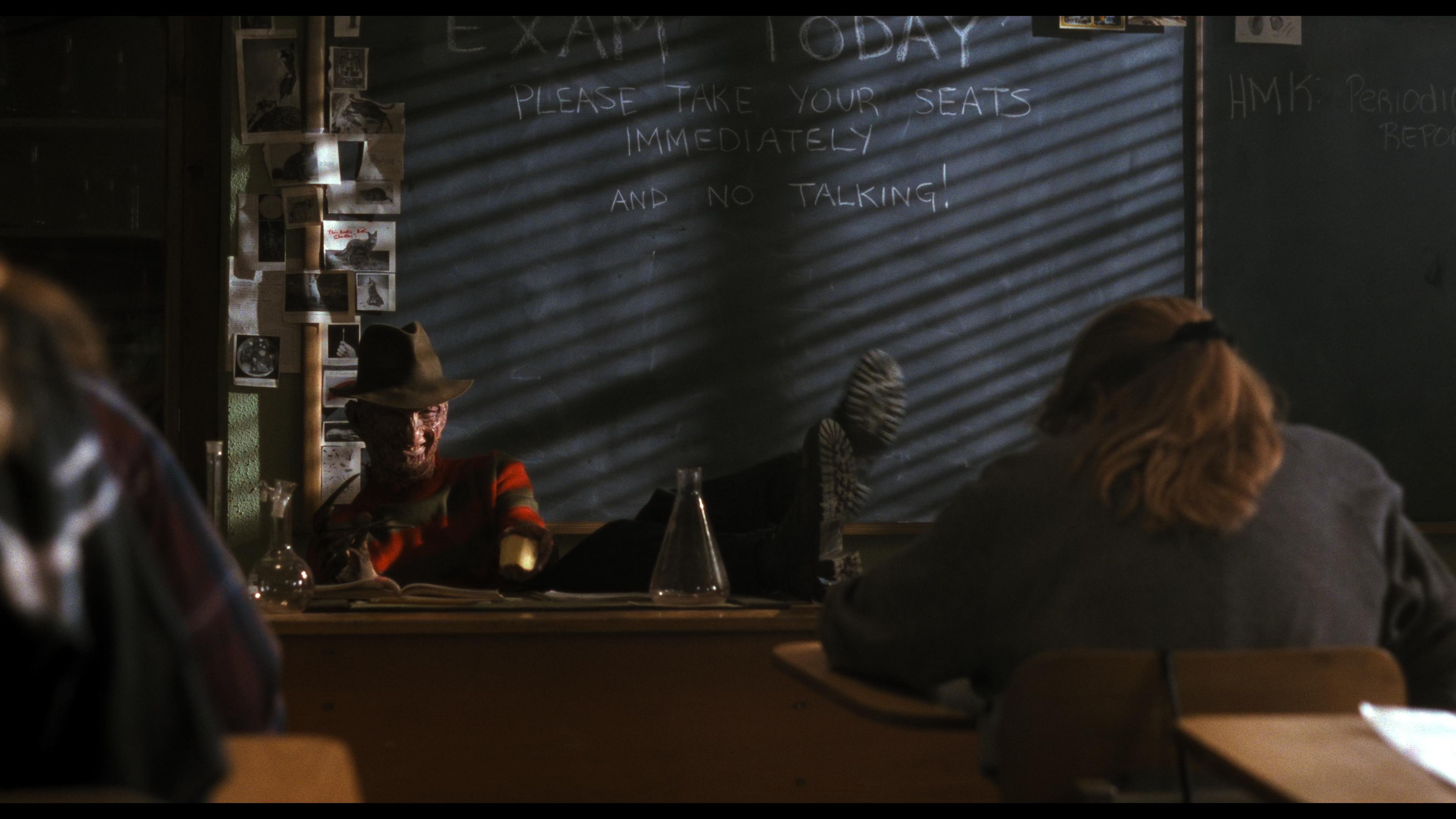
Teen warriors enter the dream world with another outstanding native 4K transfer that also reportedly comes from a fresh remaster. While not as polished and clean as the other sequels (at least, not at first glance), the video is a notable improvement with sharper details and a better refined grain structure that washes over the film-like HDR10 presentation. Faithful to the original photography, contrast and brightness are very well balanced but fall on the lower end of the grayscale without sacrificing the velvety blacks and the finer aspects of the darkest shadows. Specular highlights provide the 1.85:1 image with an energetic pop, and colors are richly saturated throughout while facial complexions appear healthy and highly revealing. (HDR10 Video Rating: 92/100)
The Dream Master
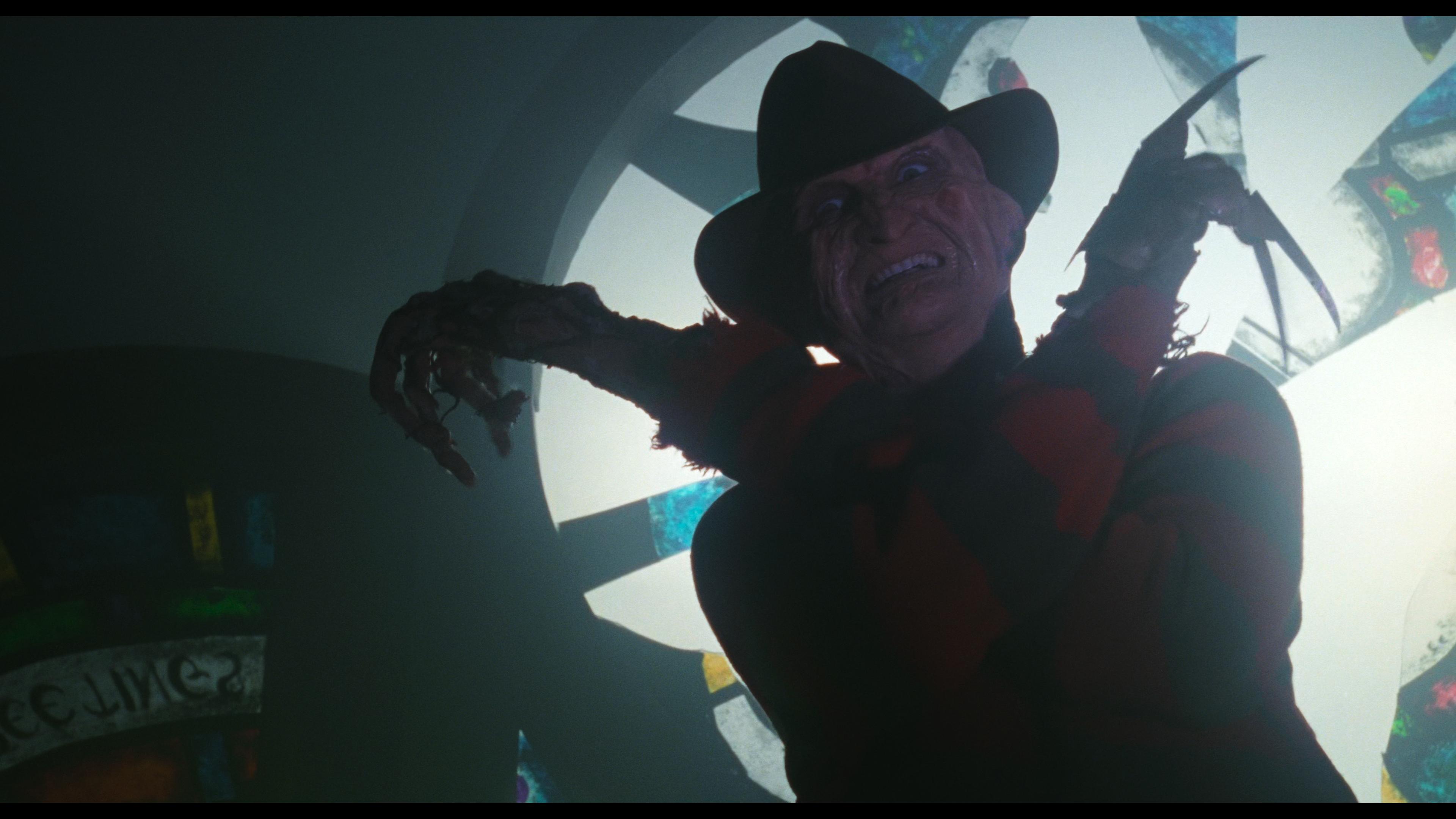
Coming from a new remaster, Freddy returns to the nightmares of kids, equipped with a vibrant and impressive HEVC H.265 encode. Primaries are fuller and more animated, giving the dream sequences a livelier, more dynamic appeal, while secondary hues are accurate and more varied. Highly revealing facial complexions come with a lifelike peach-rosiness in the entire cast. Contrast gains a generous boost without looking washed out, and specular highlights are crisp and energetic. Black levels are incredibly rich and stygian while still allowing for excellent visibility within the darkest, murkiest corners of the 1.85:1 frame. The HDR10 presentation also arrives with distinct, sharp fine lines for a majority of the runtime, but there are few softer moments sprinkled here and there that thankfully don't distract too much. (HDR10 Video Rating: 88/100)
The Dream Child
The nightmares are reborn with another surprisingly great-looking HDR10 presentation, one awash with an ultra-fine layer of grain throughout and looking very film-like. Contrast is somewhat controlled except for the dream sequences, where whites are sparkling clean and specular highlights pop with a radiant energy. Black levels are also true and accurately rendered, and shadow details are always excellent, providing the 1.85:1 image with some appreciable depth. The overall palette seems to benefit the most with primaries looking richly saturated and vibrant, while secondary hues are fuller, and skin tones appear natural with lifelike textures. Fine lines and details are also sharp and often striking, exposing every nook and cranny of rooms and in the wildly imaginative stage production of dreams. (HDR10 Video Rating: 90/100)
Freddy's Dead: The Final Nightmare
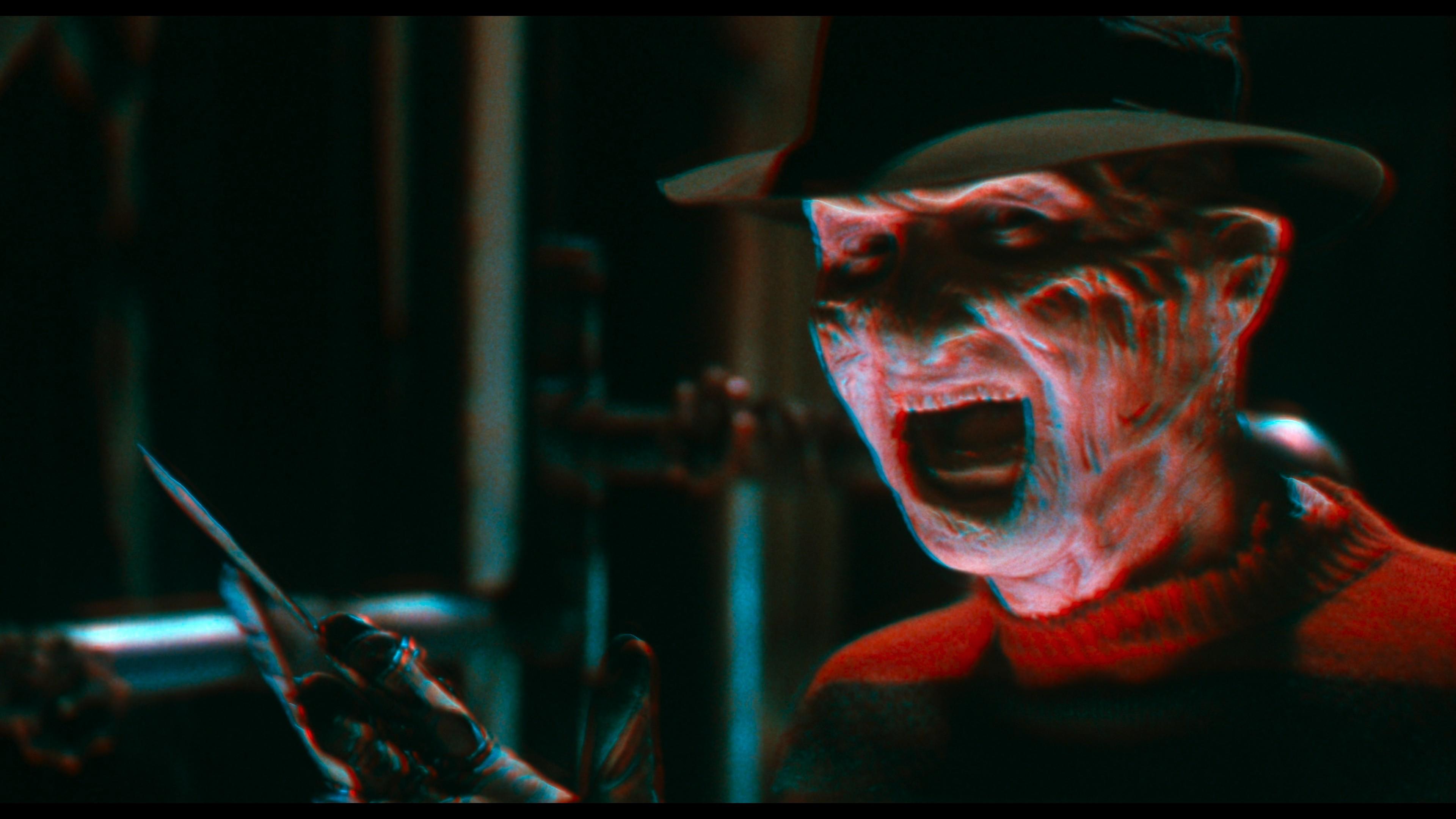
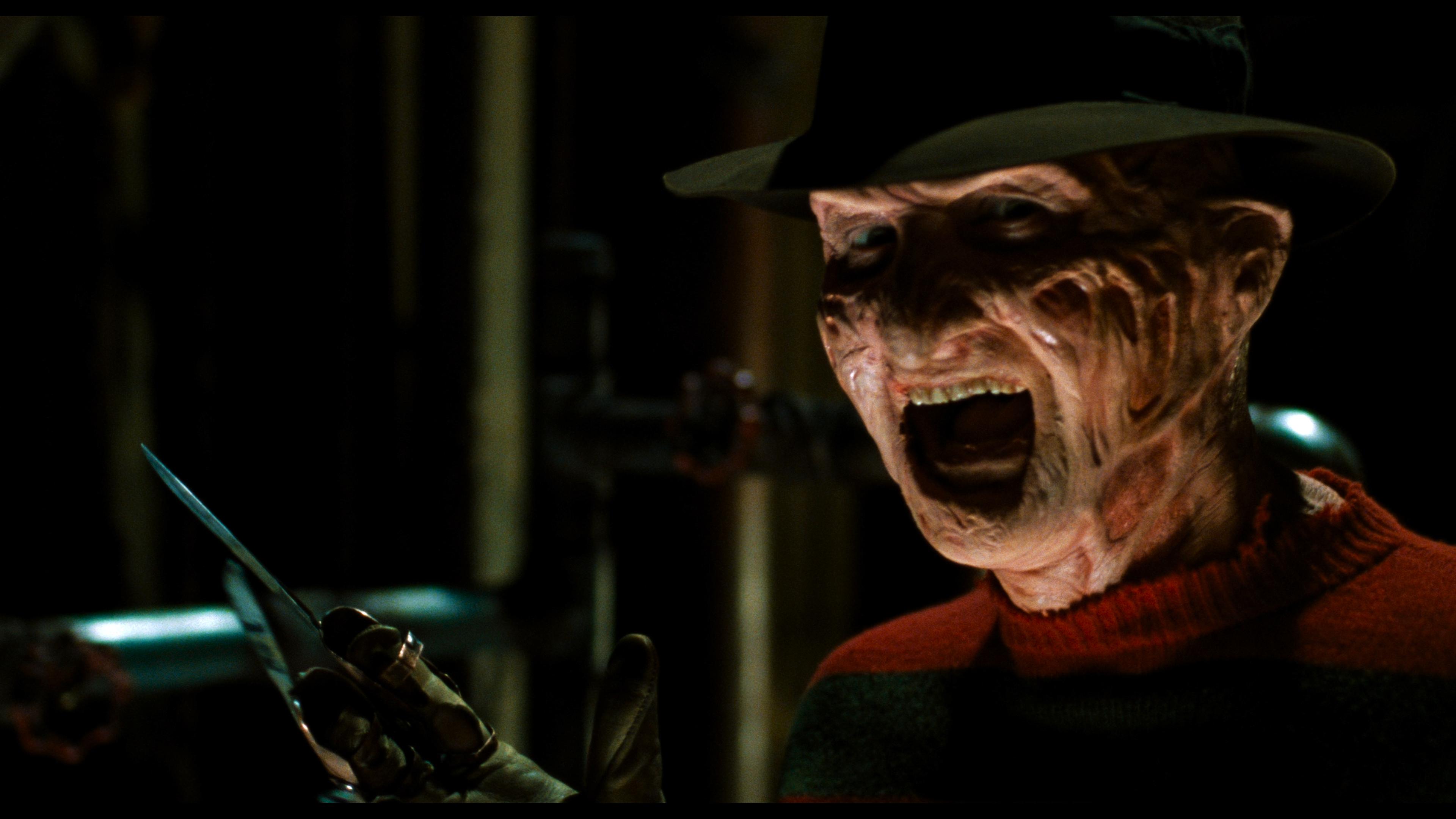
Nightmares break into the third dimension thanks to an excellent and highly satisfying HEVC H.265 encode, although the sixth entry is arguably the weakest of the bunch. Nevertheless, the 1.85:1 image is sharper and cleaner than its HD counterpart, enjoying a welcome boost in contrast but still falling on the lower end of the grayscale. Specular highlights are crisp and tight, making the dreams livelier and more spirited, and black levels are inky and spot-on. Fine lines are highly detailed and distinct, and shadows keep excellent visibility within the darkest corners of the frame. Overall color palette looks fuller and more accurate, but it's not by a great deal, although skin tones look healthy and more lifelike than before. Also, grain structure tends to fluctuate a tad from scene to scene, not to a distracting level, but still there, and the visual effects make matters worse and didn't age well.
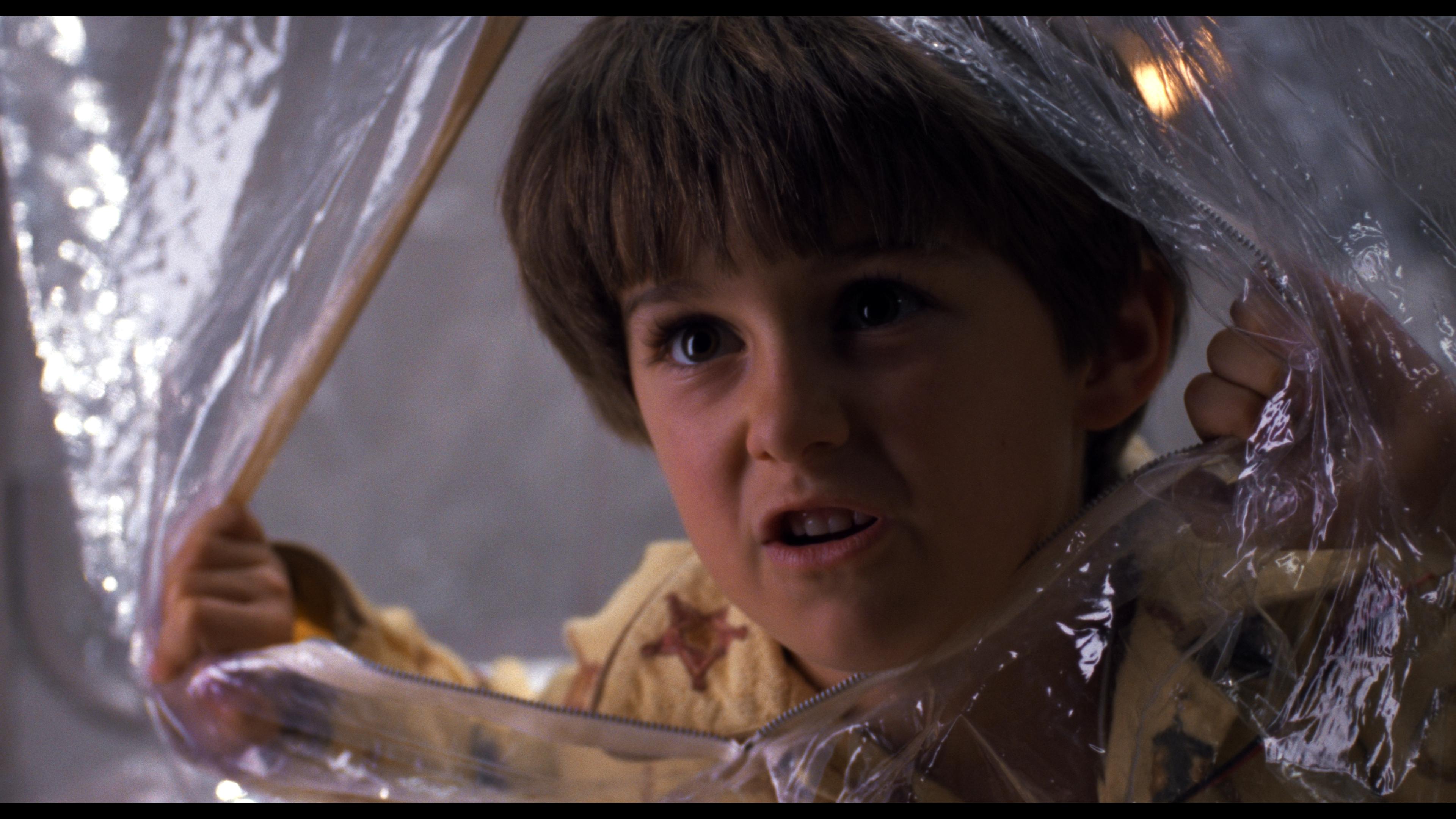
In the 3D version and while wearing the anaglyph glasses, the color palette is understandably skewed and weakened. However, surprisingly, the native 4K transfer maintains sharp details throughout, while the contrast and brightness improvements really add to the depth perception and distance between objects. Obviously, it's not up to the level of contemporary 3D technology, but all things considered, the anaglyph 3D presentation is loads of fun to watch on Ultra HD. (HDR10 Video Rating: 84/100)
Wes Craven's New Nightmare
The nightmares conclude with a fresh, new HEVC H.265 encode that boasts a significant step-up over its BD predecessor, showing sharper and more distinct details than before. Granted, the early CG and visual effects didn't age well, noticeably looking blurry and a tad noisy, but they also add to the movie's overall charm while not being too egregious. The HDR10 presentation comes with improved contrast balance and crisper, tighter specular highlights in the hottest spots. Black levels are inkier with better clarity of the finer details within the dark, velvety shadows while the native 4K transfer is awash in a thin layer of natural grain, providing the 1.85:1 image with a beautiful cinematic appeal. A richer, fuller palette supplies every nightmarish scene with an animated pop, making the iconic red and green sweater pattern that more noticeable than before, even during the gloomier sequences. (HDR10 Video Rating: 90/100)
Audio Review
A Nightmare on Elm Street
As with the video, the disc also ports over the same Atmos track as before. Here are my thoughts on the audio quality from that review:
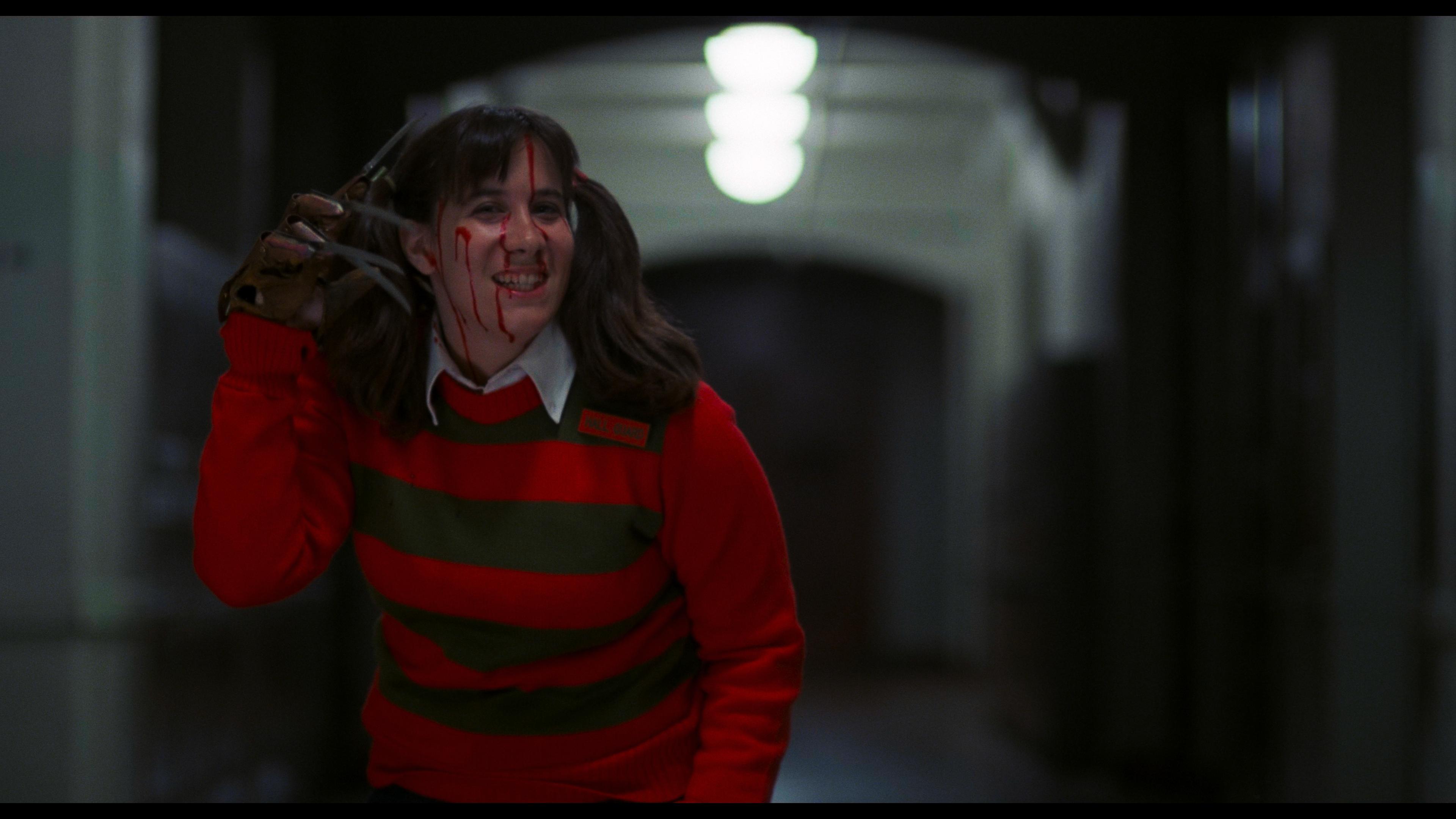
"Freddy invades the nightmares of home theaters with a fantastic, front-heavy Dolby Atmos soundtrack that immediately opens with a broad and welcoming soundstage. Charles Bernstein's haunting iconic music bleeds across the screen, to the top heights and lightly to the surrounds, enveloping the listening area with a creepy, chilling ambiance from the onset. Periodically, some atmospherics bounce between the rears and overhead, generating an eerily immersive soundfield. Imaging displays a clean, well-defined midrange, exhibiting room-penetrating clarity into the higher frequencies while vocals remain distinct and very well-prioritized during the loudest segments. Most surprising and impressive is a robust, palpable low-end that delivers a light but still noticeable couch-shaking presence on a few occasions, further adding to the scarier moments. All in all, this object-based mix is an awesome addition and complement to an outstanding video presentation.
"For purists, the movie also comes with the original monaural design, another great upgrade from the previous Blu-ray, which only offered the track in legacy Dolby Digital. The DTS-HD Master Audio soundtrack displays a fuller sense of space and presence with precise, clean dialogue in the center. The mid-range still exhibits a bit of an issue in the higher frequencies and comes off a tad bright, but for the most part, they remain fairly sharp and have appreciable differentiation. Ambient effects are discrete with great movement and separation across the screen. Low bass is adequate and responsive for a film of this vintage although it's mainly reserved for the musical score. Overall, the lossless mix of the original sound design is a great listen and addition to the 4K video." (Dolby Atmos Audio Rating: 86/100)
Freddy's Revenge
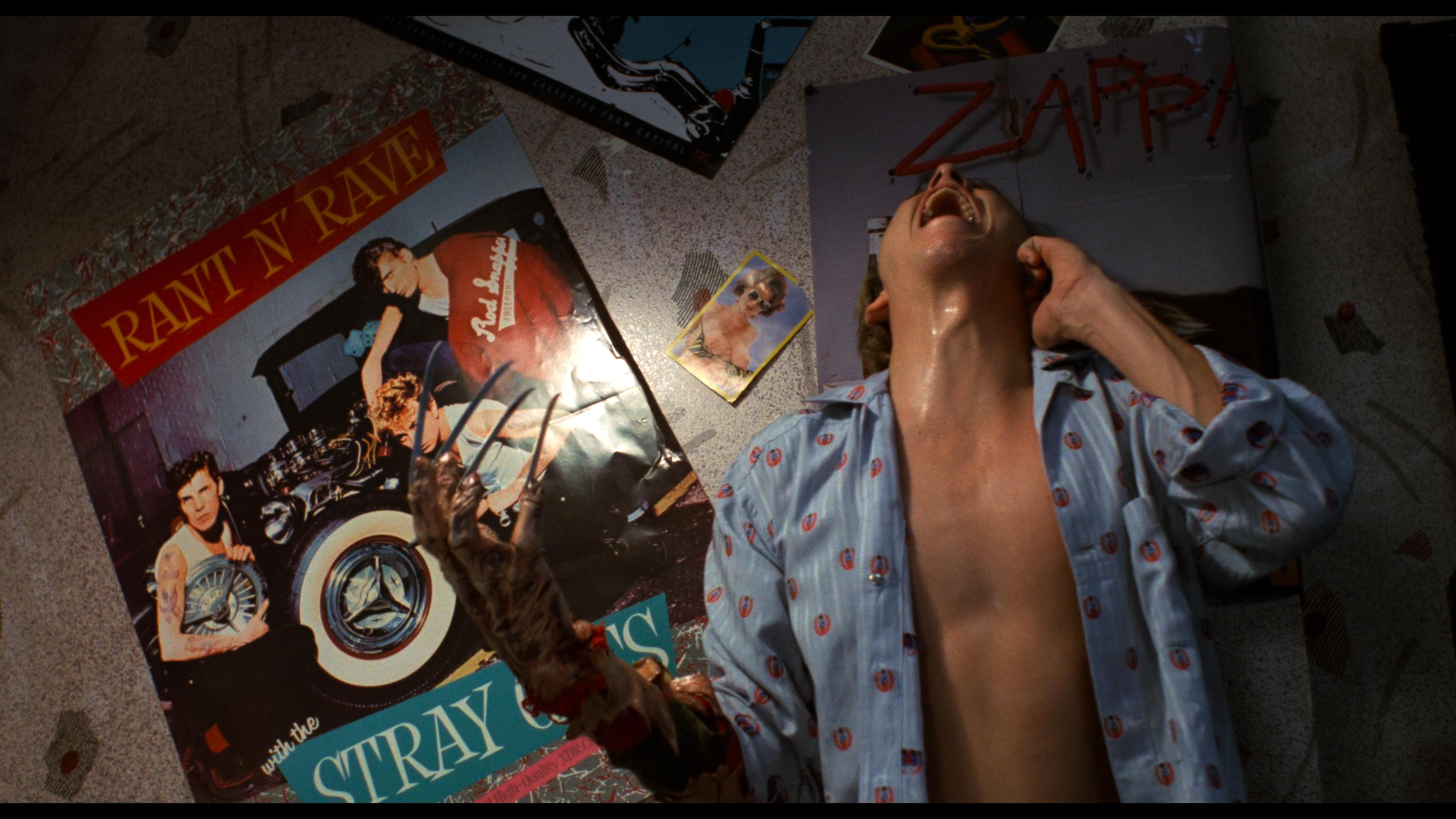
Although the original monaural tracks for each film are included, the new Atmos mixes are the primary focus of this collection review, which I'm happy to say are all shockingly good. For this first sequel, the front-heavy presentation feels broader with background activity maintaining great balance across the entire soundstage. The music and various atmospherics bleed into the surrounds and heights without feeling forced, exhibiting strong clarity and clean distinction into the higher frequencies. Dialogue is clean and precise, nicely prioritized over the loudest moments, and the low end provides some appreciable weight to the visuals. In the end, it's a great listen with several great moments of immersion. (Dolby Atmos Audio Rating: 84/100)
Dream Warriors
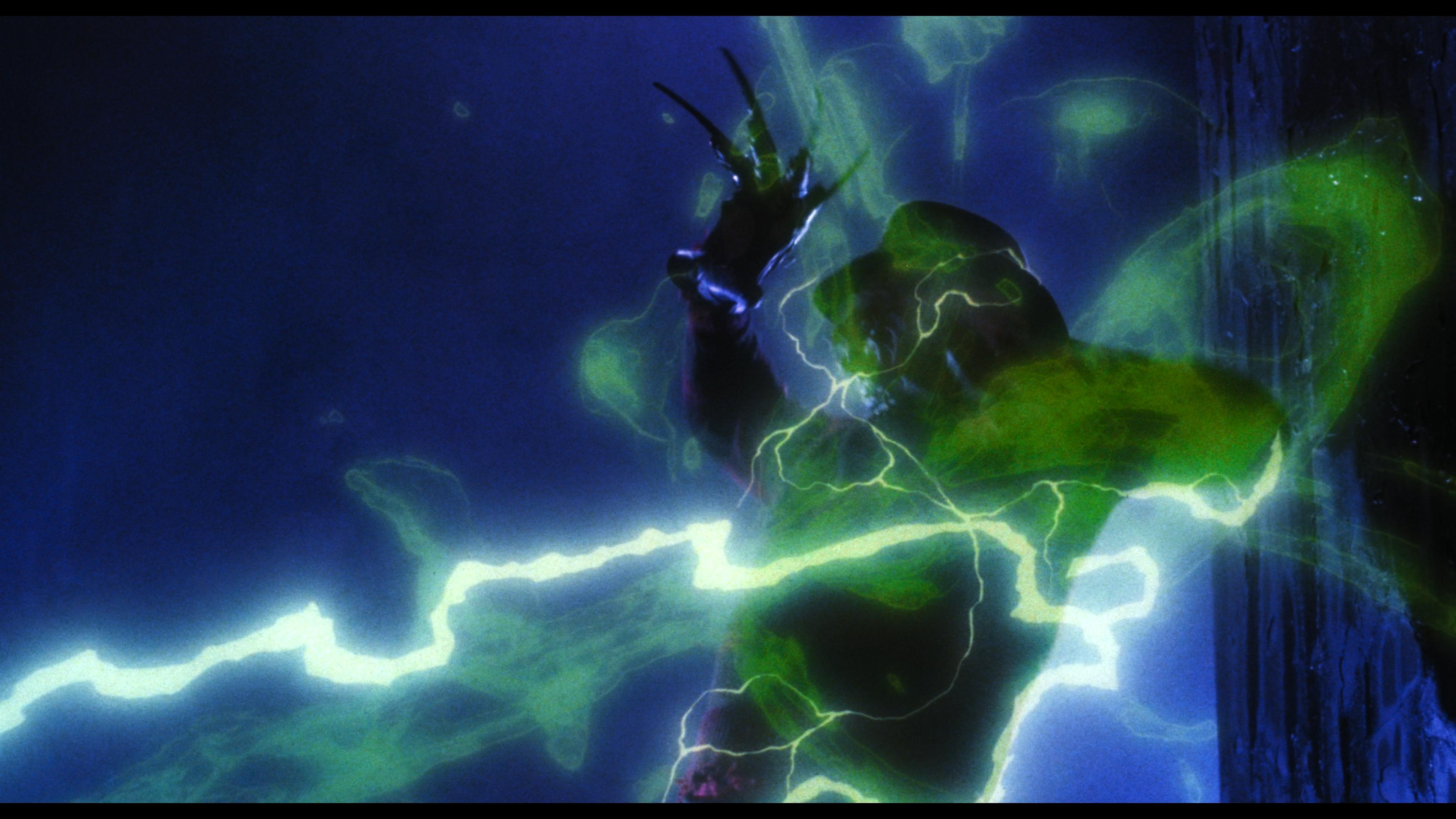
The kids are disturbed by an excellent wide and welcoming soundstage offering a clean, precise dialogue reproduction as background activity convincingly spreads across the screen and into the top heights. Occasionally, minor atmospherics subtly move into the surrounds and rear heights, nicely enhancing the soundfield and making the dream sequences amusingly immersive. The score also bleeds all around the listening area while exhibiting sharp detailing in the mid and upper frequencies. A fuller bass adds some oomph and weight to the visuals without feeling exaggerated or artificial. (Dolby Atmos Rating: 86/100)
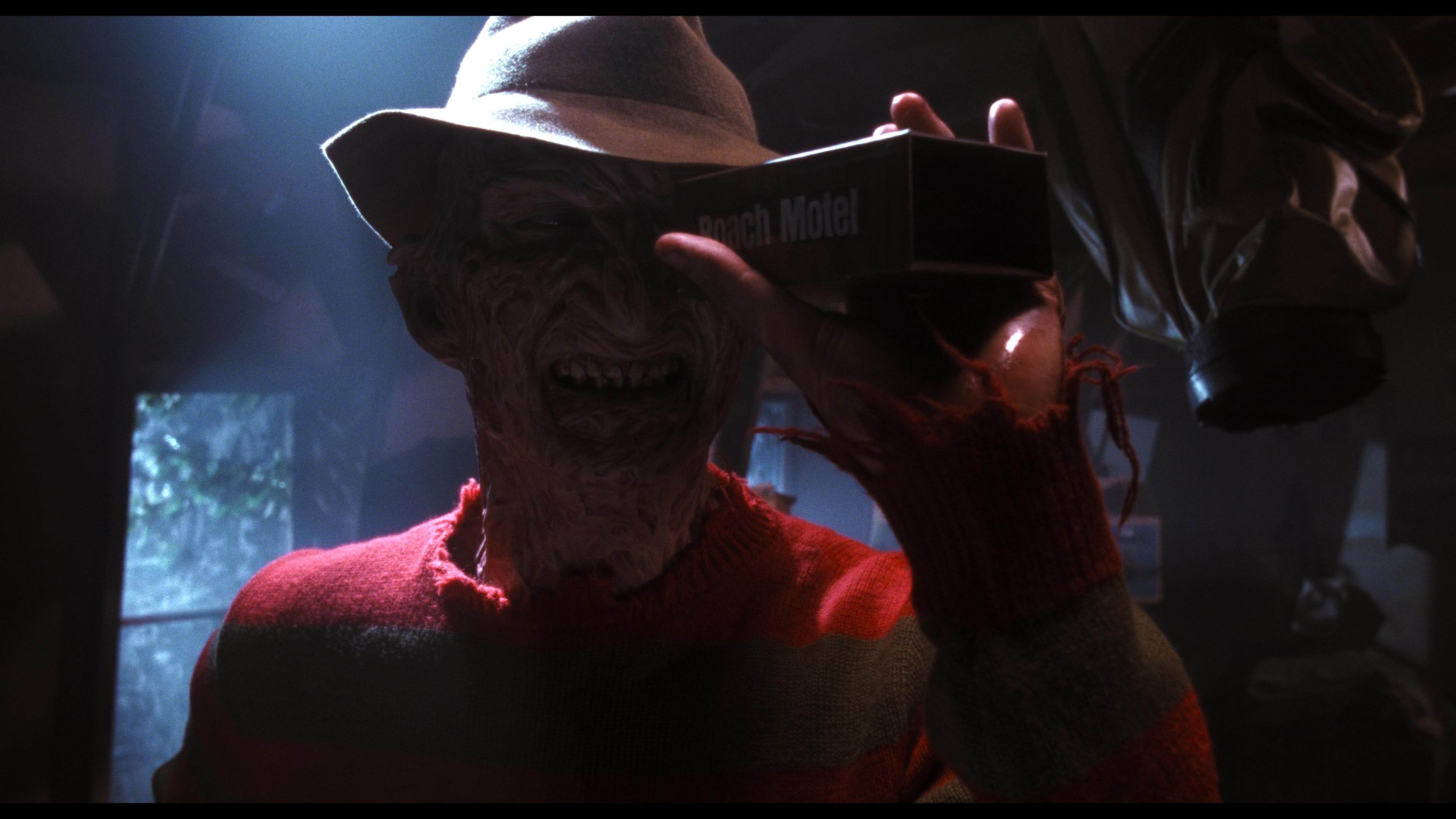
The Dream Master
The biggest surprise of the set are the next two movies with the fourth entry mostly reserving discrete effects for the dream sequences, which effortlessly pan between the surround and overhead channels, generating a highly enjoyable soundfield. Quieter moments still offer a few atmospherics bouncing between the fronts and top heights, creating a wide and engaging soundstage. The midrange exhibits superb distinction, and the score displays excellent fidelity while vocals remain precise and clear amid the loudest segments. And a stronger, more active low bass provides some depth and presence to the action and music. (Dolby Atmos Rating: 88/100)
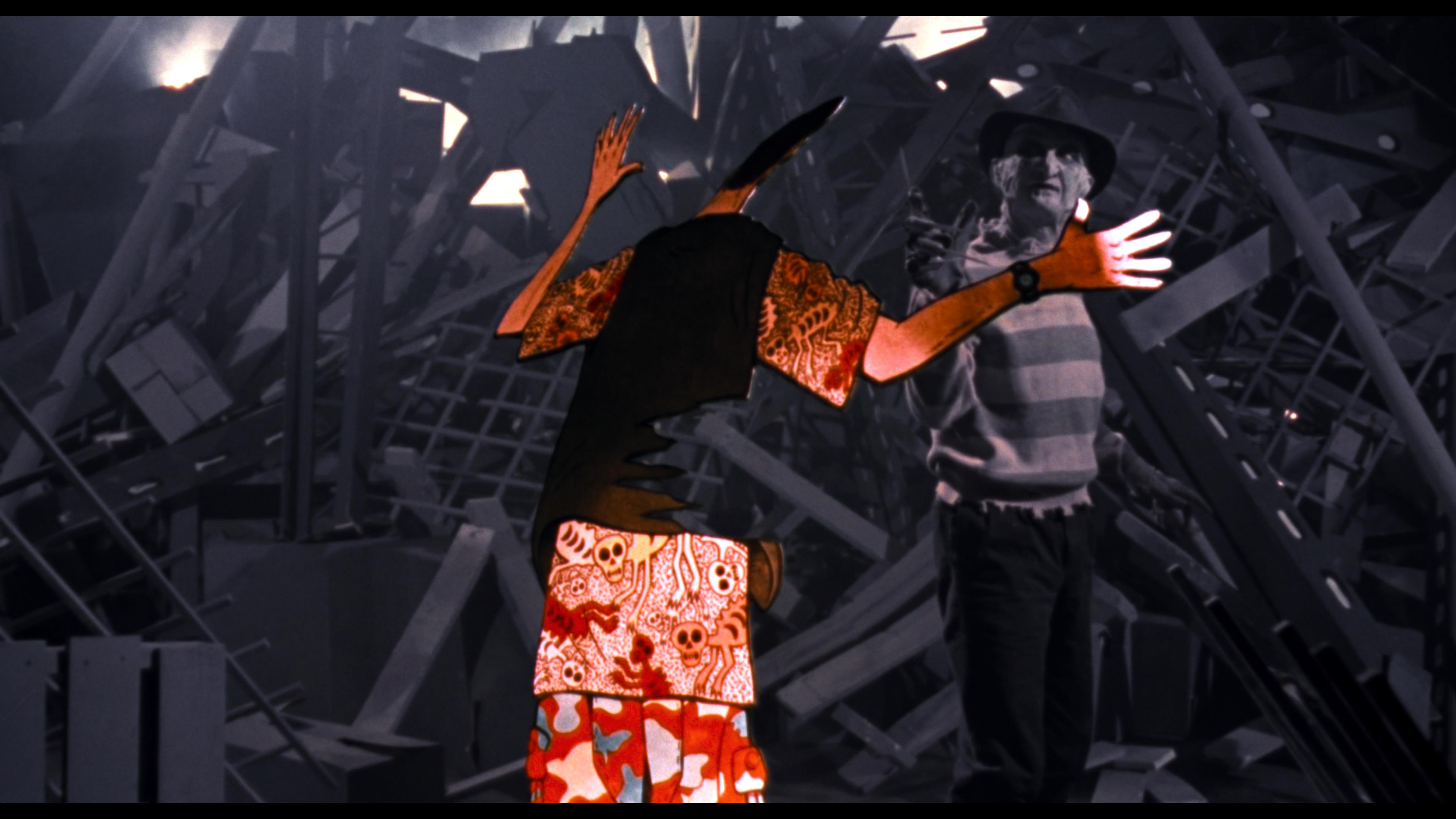
The Dream Child
Likewise, the fifth entry also benefits greatly with improved clarity and a broader soundstage, as effects and music bleed across all three channels and into the top heights. As with the previous movie, the front-heavy mix saves ambient effects for the dream sequences, which effectively move all around and overhead the listener. Imaging displays a cleaner, more distinct midrange that maintains impressive clarity during the loudest scenes, and an appropriately hefty low-end provides appreciable oomph to those visuals. With clear, well-prioritized vocals throughout, the object-based soundtrack is a notable improvement over its DTS-HD counterpart. (Dolby Atmos Rating: 88/100)
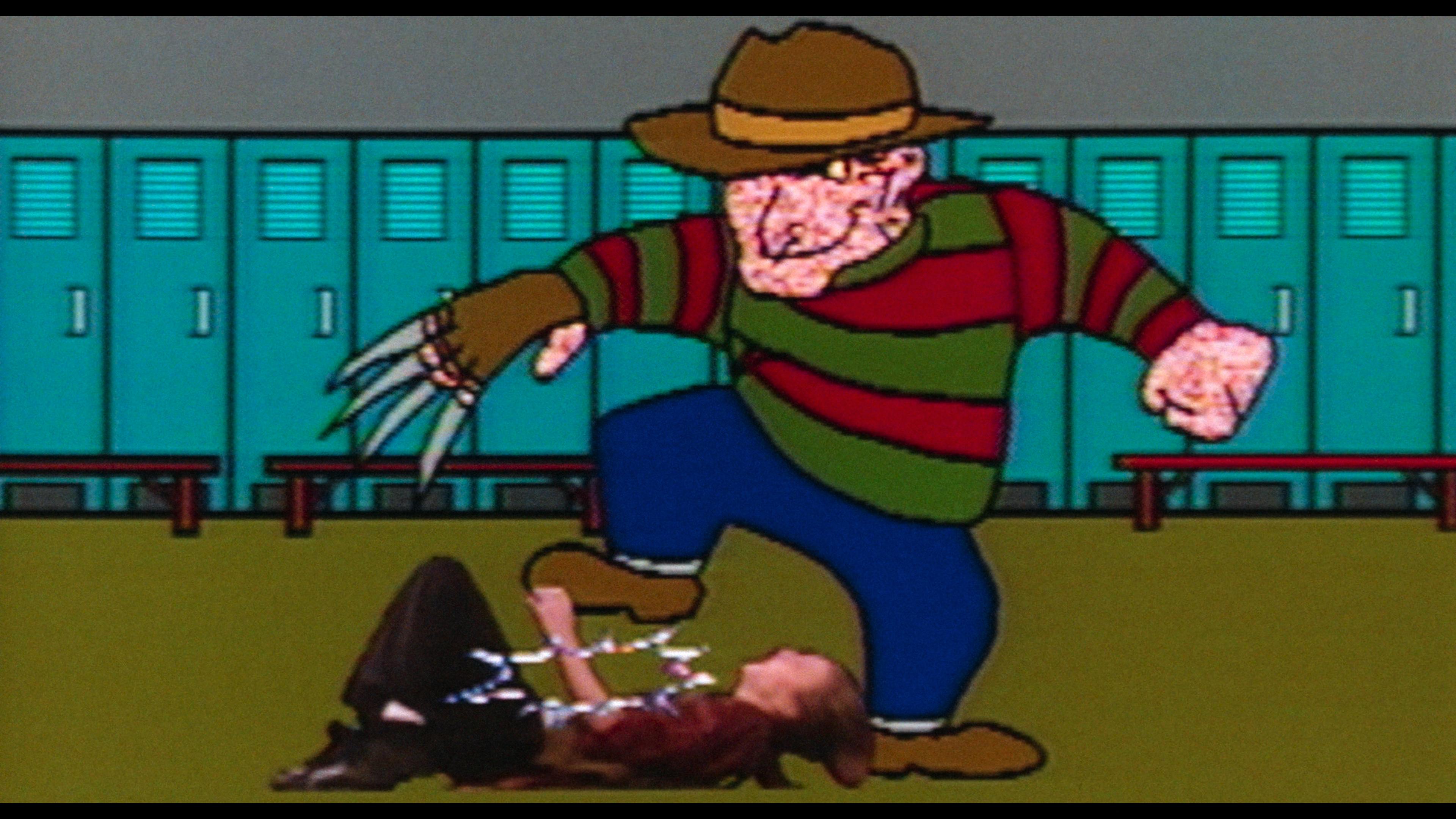
Freddy's Dead: The Final Nightmare
The final nightmare also impresses with a satisfying and enjoyable object-based track that proficiently spreads many atmospherics into the surrounds and height, which nicely enlivens not only the dreams but also (and most importantly) the 3D sequence. Imaging feels broader and more spacious with excellent balance while displaying strong clarity and separation in the midrange. Low-frequency effects are also a bit more robust and fuller, nicely providing a punch and oomph to the action scenes. All the while, dialogue remains intelligible and well-prioritized from start to finish. (Dolby Atmos Rating: 84/100)
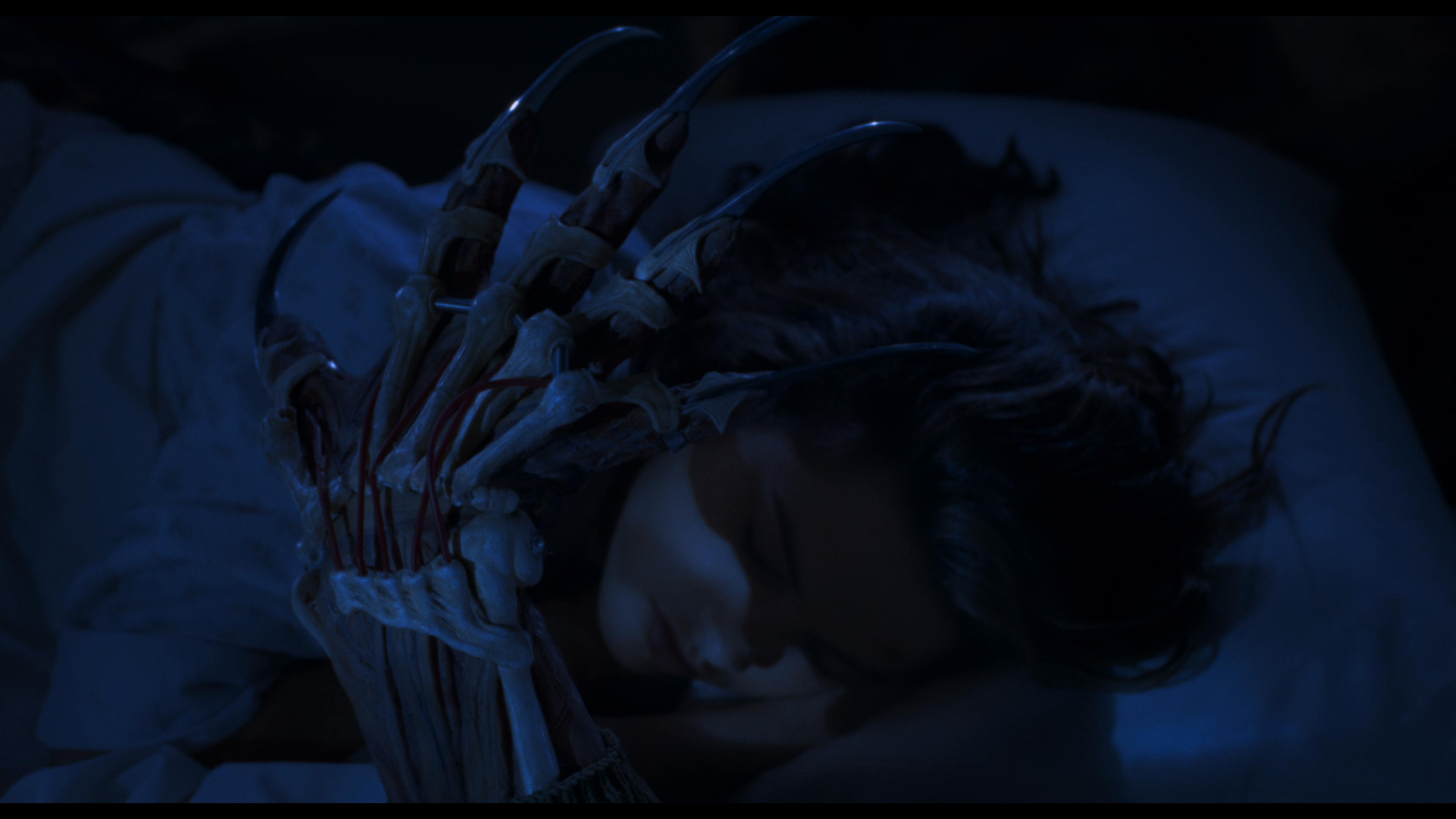
Wes Craven's New Nightmare
The final entry comes with clean, precise dialogue throughout while the rest of the soundstage is well-balanced and expansive with good channel separation and a detailed mid-range. A fuller, deeper low end provides some much-needed depth and weight to the visuals and occasionally rumbles the couch, especially during the earthquake scenes. Rear activity is not as consistent as the other, but several discrete effects employ the surrounds and heights in a few choice moments, particularly the climactic dream fight. The musical score also displays improved fidelity and detailing as it bleeds into all the channels, expanding the soundfield with a pleasing atmosphere. (Dolby Atmos Rating: 86/100)
Special Features
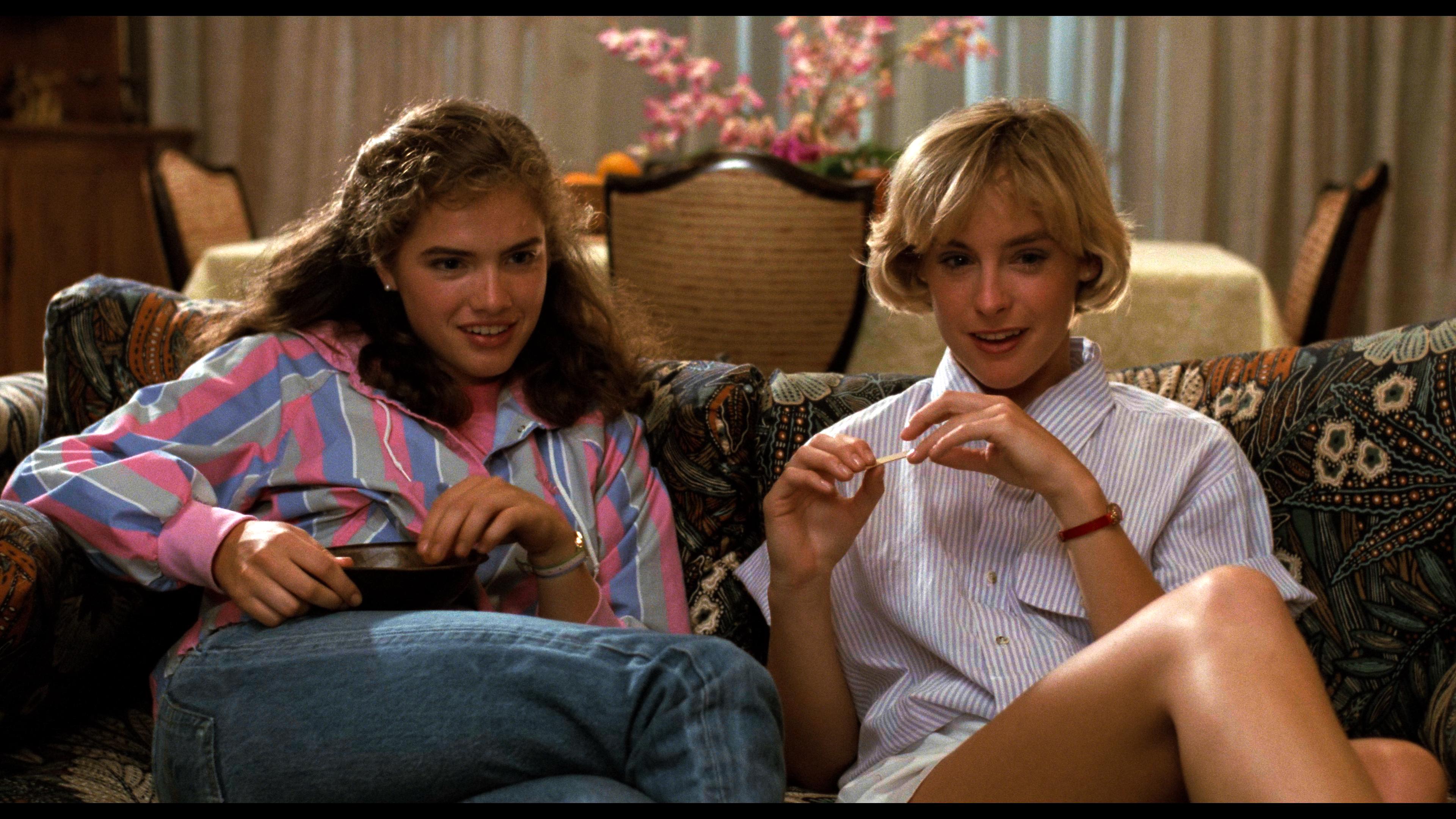
For this UHD version, Warner Bros. and New Line Cinema have ported over the same collection of supplemental material as the previous Blu-ray set, except that the special features from the DVD disc of before now share the same space as New Nightmare.
A Nightmare on Elm Street
- Audio Commentaries
- Never Sleep Again (HD, 50 min)
- The House That Freddy Built (HD, 23 min)
- Night Terrors (HD, 16 min)
- Alternate Endings (HD, 5 min)
- Fact Track
- Focus Points
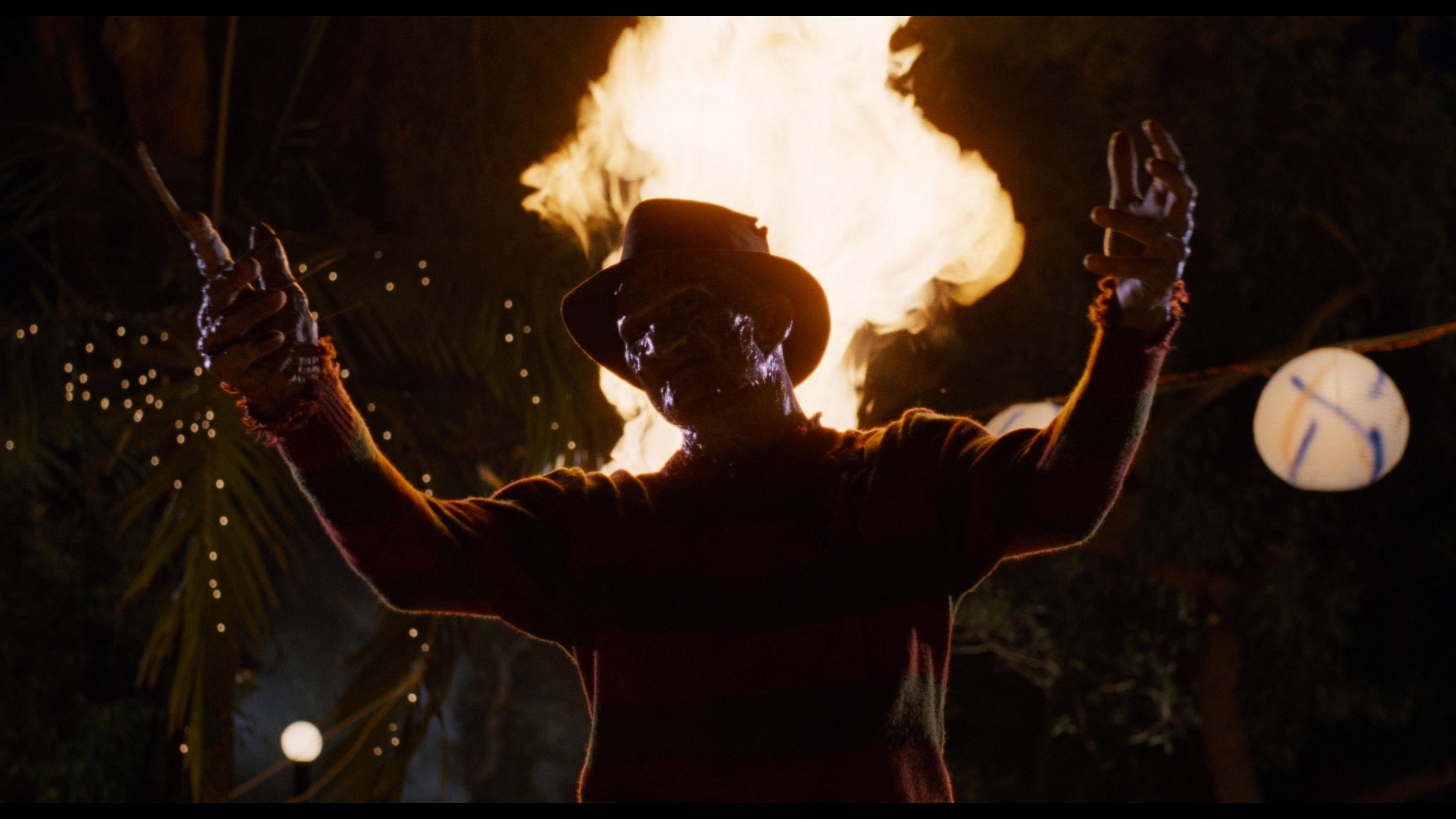
Freddy's Revenge
- Heroes and Villains (SD, 6 min)
- Freddy on 8th Street (SD, 5 min)
- Psycho Sexual Circus (SD, 3 min)
- The Male Witch (SD, 3 min)
- Trailer (SD)
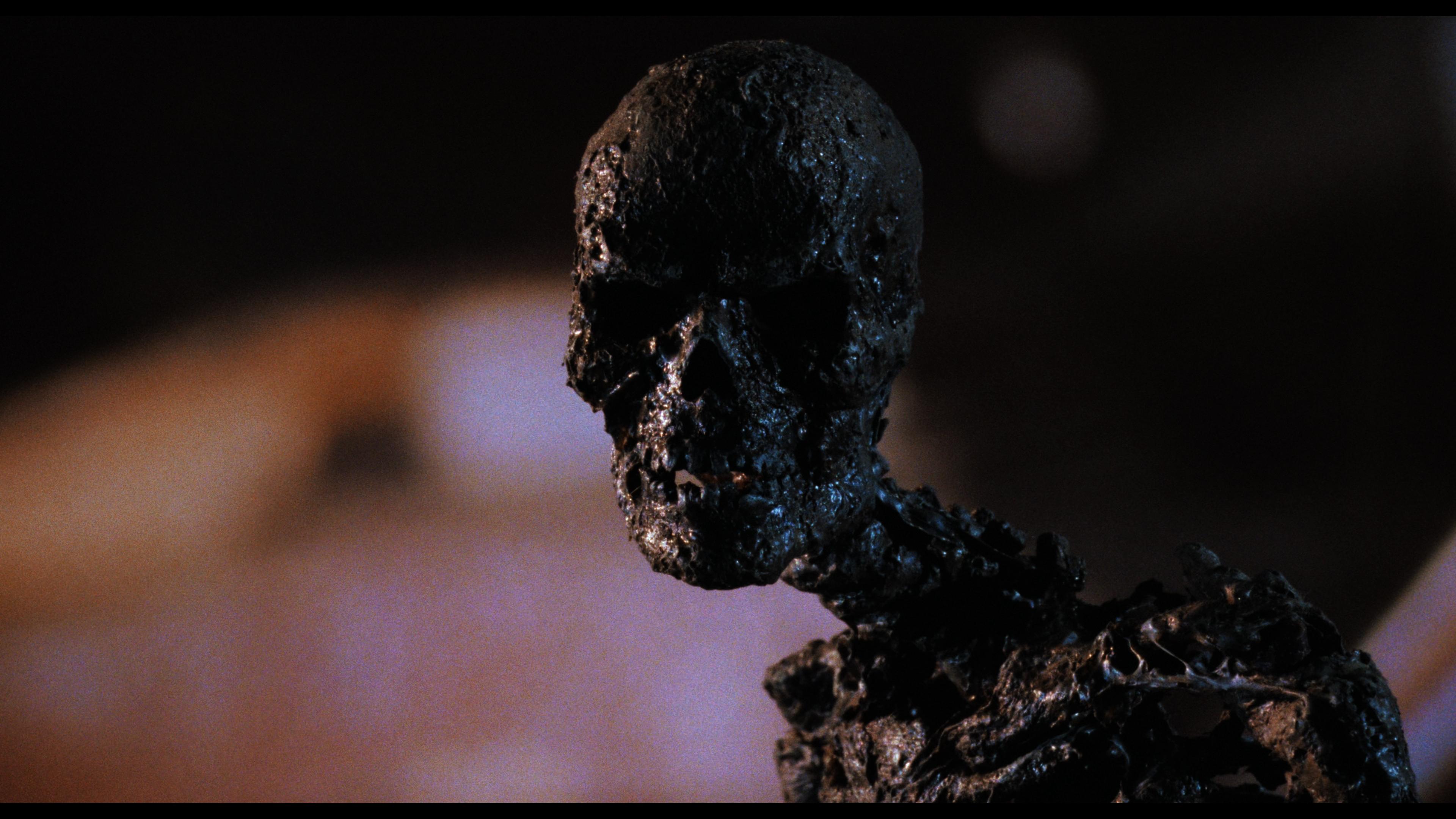
Dream Warriors
- Behind the Story (SD, 27 min)
- Music Video (SD, 4 min)
- Trailer (SD)
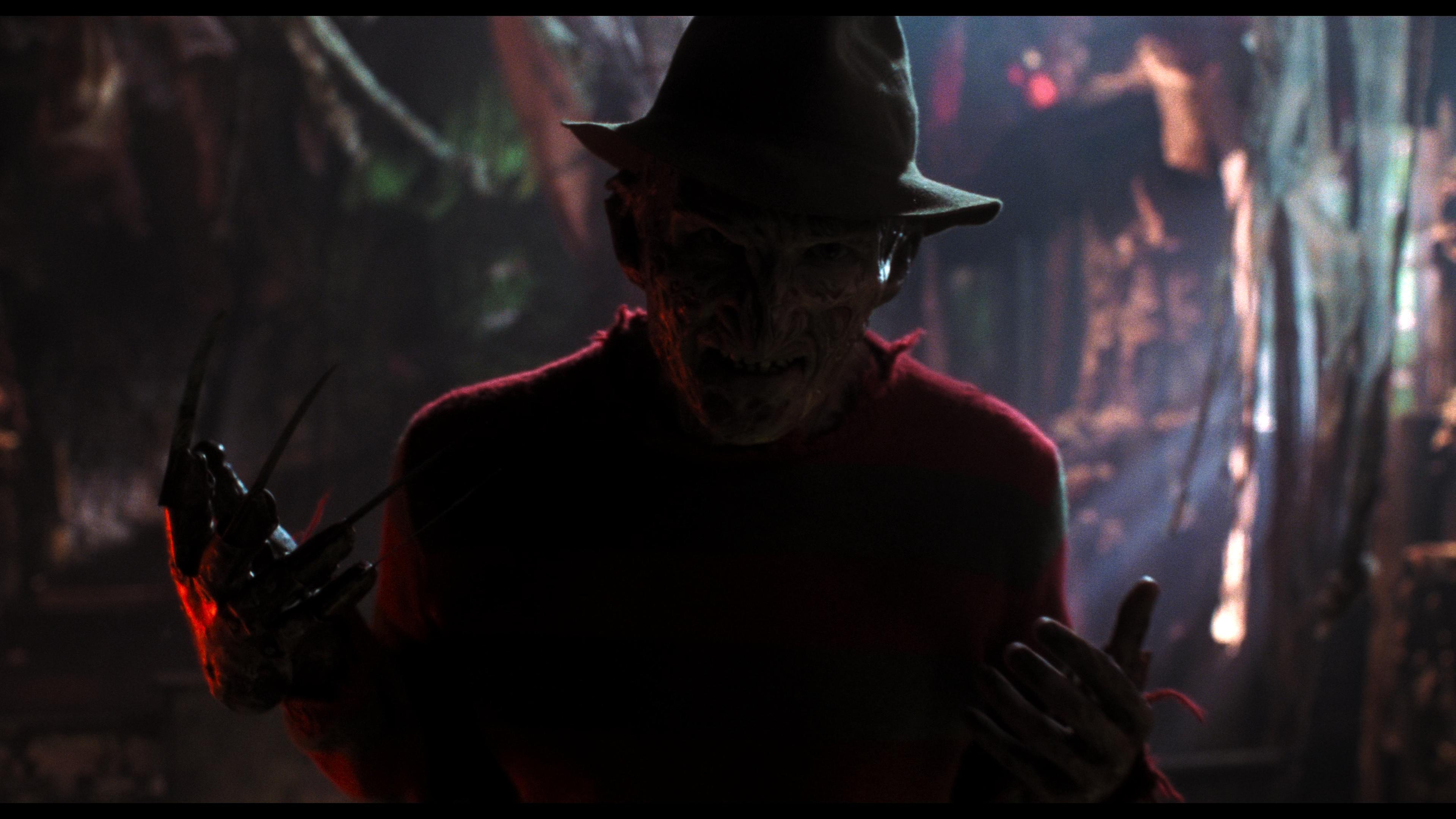
The Dream Master
- Krueger, Freddy Krueger (SD, 8 min)
- Hopeless Chest (SD, 4 min)
- Let's Makeup (SD, 2 min)
- The Finnish Line (SD, 2 min)
- Trailer (SD)
The Dream Child
- Behind the Story (SD, 15 min)
- Music Videos (SD, 7 min)
- Trailer (SD)
Freddy's Dead: The Final Nightmare
- Rachel's Dream (SD, 3 min)
- 3D Demise (SD, 2 min)
- 86'D (SD, 2 min)
- Hellraiser (SD, 1 min)
- Trailer (SD)
Wes Craven's New Nightmare
- Audio Commentary
- Freddy's Nightmares (SD, 94 min)
- Welcome to Prime Time (SD, 50 min)
- Fear Himself: The Life and Crimes of Freddy Krueger (SD, 30 min)
- Conclusions (SD, 18 min)
- Becoming a Filmmaker (SD, 8 min)
- Filmmaker (SD, 5 min)
- Two Worlds (SD, 2 min)
- The Problem with Sequels (SD, 2 min)
- An Insane Troupe (SD, 1 min)
- Trailer (SD)
Of the hundreds of movies released during the golden age of slasher films, only a handful of notable figures survived the 80s as lasting icons of the genre. Though they've become caricatures of their former, brutal selves, their names live on as embodiments of all the things we demand in contemporary horror. Every year around Halloween, we celebrate these fictional characters by donning their faces and weirdly pretending to be just like them for one night. Wes Craven's original is one such film that has left a major impact and continues to be just as entertaining today as when it originally premiered, leaving behind a cultural legacy and several sequels.
Entering the dreams of the Ultra HD world, Warner Home Video and New Line Cinema present the franchise in an attractive box set, simply dubbed A Nightmare on Elm Street: 7-Film Collection, with all seven films being granted their own dedicated UHD disc. And all seven of them arrive with improved, largely beautiful-looking and remastered HDR10 presentations, along with impressive and highly satisfying Dolby Atmos soundtracks. Sadly, the supplement material is the same as the previous Blu-ray collection, yet the overall UHD package is worth the purchase and Highly Recommended.
All disc reviews at High-Def Digest are completed using the best consumer HD home theater products currently on the market. More about the gear used for this review.
-
 Strange Bedfellows: Why Horror is a Natural Fit for 4K UHD & Blu-ray Physical MediaBy:
 -
 Turbine Is Back In Action for John Watts’ ‘Clown’ on 4KUHD Mediabook November 13th!By:
 -
 The Horror of 'Clown in a Cornfield' Comes Home With A 4K UHD SteelBook from RLJE Sept. 9th!By:
 -
 Turbine Sinks Their Fangs into Our Necks With NEW Renfield and Abigail 4K UHD Mediabooks!By: