Tommy: 50th Anniversary 4K Ultra HD Blu-ray
4K UHD Review By: Jesse Skeen
One of the essential "play it loud" musical films of the rock era, Tommy gets a 50th anniversary 4K release from Shout Select. First conceived by The Who in 1969 as a rock opera, director Ken Russell brought it to the screen in 1975 with a few tweaks and additional songs. This 4K disc is a slight visual upgrade from Sony's 2010 Blu-Ray (released for the film's 35th anniversary), but the lack of any extras is quite disappointing for a Shout Select title. Recommended.
Storyline: Our Reviewer's Take
Tommy was conceived by The Who as more than just an album of songs but a rock opera that told a story- something that hadn't been done before in rock music. It was released in 1969 as a 2-record set and often played in order by the band at live shows, promoted to make one think it was the most important story ever told. A separate album performed by the London Symphony Orchestra was also released, presented in a bit more formalized manner with orchestra and chorus. In 1975, Ken Russell, with producer Robert Stigwood, brought out this movie which takes a few liberties with the original material and promises that "your senses will never be the same." The story itself might be a bit silly if you look too deeply into it, but most of the songs are strong. The movie uses songs and music to tell the entire story without spoken dialogue and hardly any sound effects corresponding to happenings onscreen. The world it takes place in is quite odd as well, with most things appearing just a bit stranger than usual. This was a few years before music videos took hold, making for a groundbreaking experience that still holds up well today.
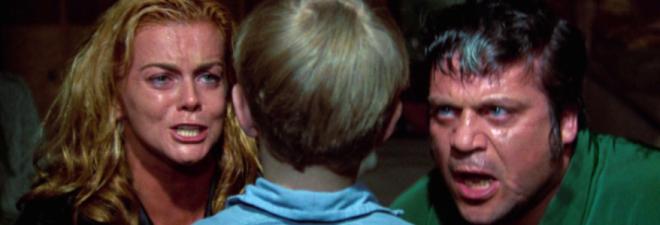
The title character is played by The Who's lead singer, Roger Daltry. The backstory is that his fighter-pilot father (Robert Powell) is shot down during World War II shortly before Tommy is born to his mother, Nora (Ann-Margret). With his father presumed dead, Nora raises Tommy on her own and brings him to a holiday camp (which seems to be mainly a British thing). There she meets one of the hosts, Frank (Oliver Reed) and falls in love with him. The two soon move in together, with Frank promising to fill the empty space left by Tommy's father. But - spoiler alert - one night, Tommy's father miraculously returns alive and well. He walks in, horrified to find Nora and Frank in bed together, and Frank instinctively throws a lamp at him, knocking him dead, with Tommy watching it all from the doorway. The couple then sings loudly into his face, "You didn't hear it, You didn't see it, You won't say nothing to no one ever in your life!" This sets the stage for the intense musical to come with Pete Townshend and Elton John drppong by to lend their vocals to this auditory adventure.
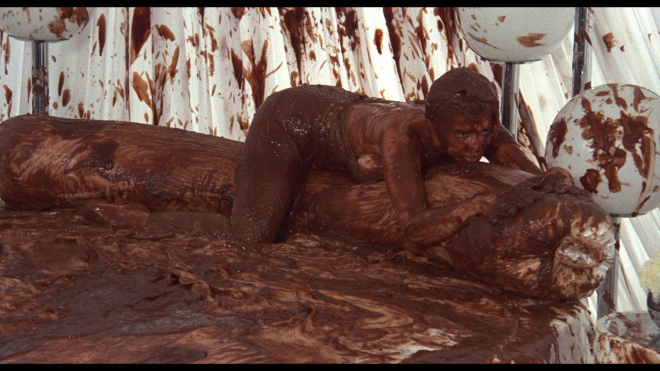
The set designs make the time period a bit ambiguous, but despite the original music this is clearly more a 70s film than one from the 60s. The year 1951, moved ahead a few years from the original album, is given in one song where Tommy is still a child. Later, the year 1975 can be seen briefly on a car decal, but it's been said that efforts were made not to include any pinball machines from later than 1969 when the original album was released. While plenty of rock music elements from the original songs remain, a heavy amount of mid-70s synths are added. Producer Robert Stigwood would be a big name in disco music shortly after this movie's release. A few new songs were added as well, most notably Ann-Margret's solo number "Champagne" where she has a bit of a breakdown watching Tommy's pinball tournament on TV - she's clearly taking advantage of the money his fame has brought, but the lyrics also show her concern for Tommy's condition. This number culminates famously with a blast of beans (from a commercial) shooting out of the TV screen into her perfect white bedroom, which she then writhes around in.
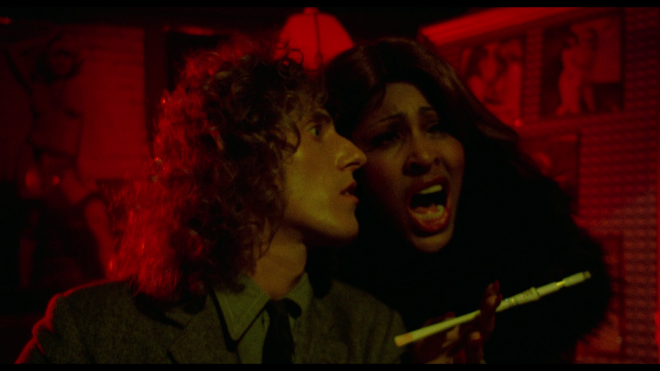
Many of the casting choices were quite interesting- Oliver Reed stands out as Tommy's new father figure. Being the main cause of the real father's death, he comes across as a selfish oaf. Concern over Reed's questionable singing talent was expressed during production, but in the end, it worked out well for the character as it just makes him all the more despicable with some words shouted more than sung. Another interesting casting choice is Jack Nicholson as a doctor- he also sings here but pulls it off better than you might expect.
Overall, when viewed in the right conditions, Tommy succeeds in being more of an experience than a simple movie.
Vital Disc Stats: The 4K Ultra HD Blu-Ray
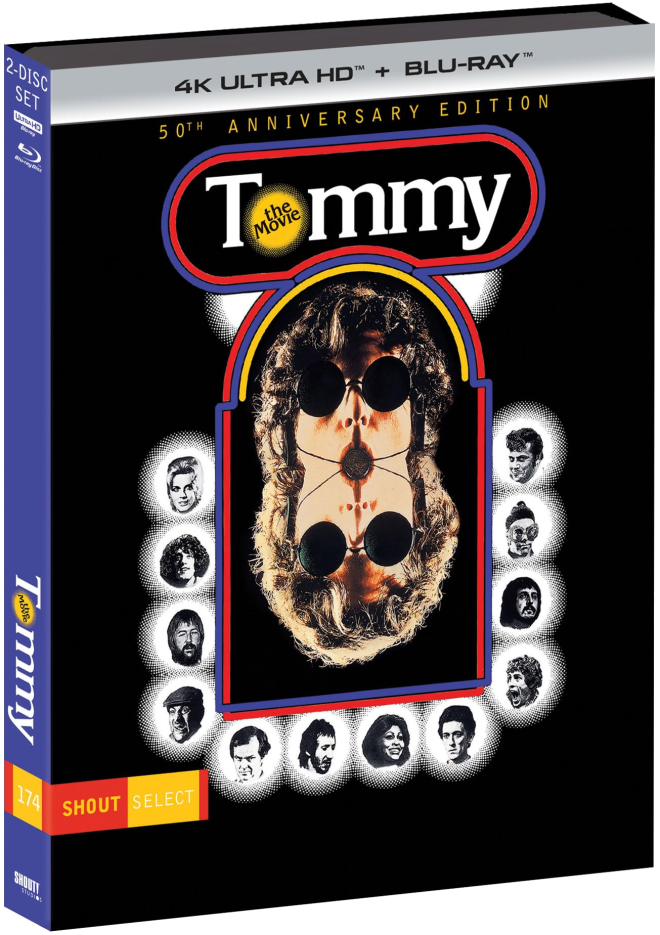
Tommy arrives on 4K Ultra HD from Shout Studios as a Shout Select title, packaged with an accompanying standard Blu-Ray disc in a black case with the iconic poster art on the front. No printed inserts are included. An unsealed slipcover is included with the first printings. The content on both discs is identical and quickly go to the main menu accompanied by quick-cutting clips from the movie. (Pictures in this review were taken from the standard Blu-Ray.)
One caveat (or nit-pick if you will) about this release, I have five previous video releases of Tommy, the oldest being on the short-lived CED videodisc format released in 1982. All of these begin with the Columbia Pictures "Starburst" intro logo accompanied by music. That intro is retained on this release but is completely silent. Also of note is that this intro dates a year after Tommy was released, I was just a bit too young to have seen this movie theatrically during its original release, but it was said to have originally opened with the previous silent "Columbia" logo. The speculation is that all video transfers have been from a reissue print, but it's curious that the opening music is missing here. The Dolby System logo in the end credits may also have been added for that reissue; more on that in the "Audio" section.
Video Review
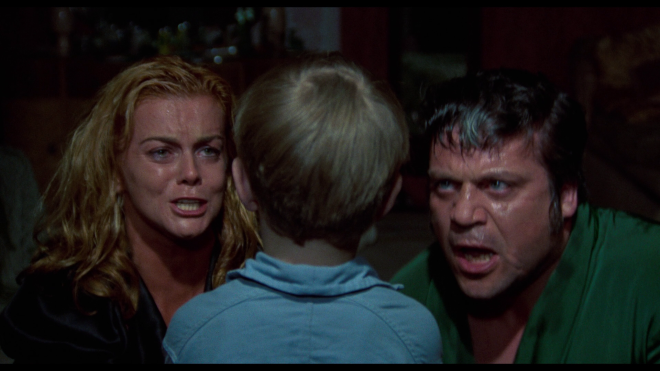
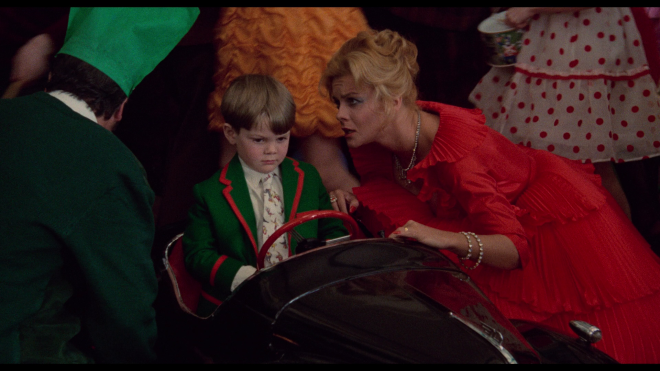
Tommy gets a 4K transfer here with Dolby Vision HDR (and HDR10), in its intended 1.85 aspect ratio. Having seen several transfers of this going back to the early '80s, it should be kept in mind that despite the great visuals, this has never been an incredibly great-looking movie. Mainly the colors have always appeared just slightly subdued to me, which is sometimes done intentionally. This presentation keeps everything the way it should be without any obvious digital trickery or "clean-ups." Film grain, which varies from scene to scene, is kept intact. I've never noticed any obvious dirt or scratches on previous transfers but any of those seem to have been cleaned up here. While the Superbit DVD release looks "good enough" on modern displays, the Blu-Ray and now 4K releases have cleared up a few more details that were harder to make out before. Most notable here is being able to read most of the newspaper Oliver Reed holds in one scene. Reviews of the previous Blu-Ray mentioned some compression artifacts and banding. Checking that older disc, I did see some slight instances when I was looking for them; on this triple-layer 4K disc, there are none to be found.
Audio Review
"Tommy, can you hear me?" This is definitely one of those movies that is nothing without the sound. It was the only movie to use a format called Quintaphonic Sound, which used the three front magnetic audio channels on 35mm films (optical Dolby Stereo wouldn't exist until 1976; prior to that, stereo audio on both 35mm and 70mm film was confined to magnetic tracks). The left and right channels were run through a decoder similar to that used for the era's quadraphonic records to produce two surround channels, and the center channel was left as it was. Checking a few songs, I found that many of them had the vocals isolated in the center with no music, but some of the instrumentation was included in the center during some songs. More recent movies have been mixed in a similar manner, and it's always fun to isolate the center channel and hear the vocals by themselves.
The surrounds are active throughout the movie, but I wouldn't say they go as crazy with them as with some recent movies and with past and current surround music mixes (I do not adjust the levels of my speakers for every movie; I set them according to test tones and any times the surrounds are too low or too high is the fault of the mix.) You'll still be quite pleased if you're a sound nut like me, though. There are a few instances where guitars pan in a circle across the front and rear channels, and there are also a few sound effects in the rears, such as planes during the scenes showing Tommy's father at war. I'd say the most lacking use of the surrounds is when choral vocals are kept up front, but that's a relatively minor thing. (By the nature of the matrix surround format, these vocals do carry into the surrounds there.)
The Quintaphonic format had no LFE channel, but on this disc, a silent .1 channel is still included in the 5.1 DTS-HD MA track. It was left off of the previous Sony Blu-Ray, so some sound systems would derive audio for the subwoofer in that case; this configuration ensures it stays quiet. Carried over from the previous Blu-Ray is a newer 5.1 mix, which does use the LFE but not in an overwhelming manner; it mainly punctuates some of the music. This mix was done closer to modern standards, but the differences are mostly subtle in comparing the two. New to this release is a 2-channel track that supposedly duplicates the optical Dolby Stereo track included on later prints and the pre-DVD video issues. I've read many varying accounts of which movie was the very first to use the optical Dolby Stereo format. Some have said it was Tommy, others have said it was Ken Russell's follow-up, Warner's laserdisc of A Star Is Born from 1976 also claimed that was the first movie to use the format.
I'll note that having lived in the same apartment for over 20 years, I have luckily never received any complaints from neighbors about my sound system while I had several at my previous residence, but that changed when I got a knock at my door from my upstairs neighbors during the "Eyesight to the Blind" number viewing the Blu-Ray for the first time so this movie holds a special honor for that. Regardless, this movie simply demands to be played as loud as your neighbors and/or equipment will tolerate.
Special Features
Yes, that is a zero-star rating. There are no extras whatsoever to be found here, not even a trailer. I'm not one to condemn a release for lack of extras, as the movie is the main attraction, and in some case,s extras might not even be available. But in the case of Tommy, there HAS been a special edition released in the UK, first on DVD as a 2-disc set and a later Blu-Ray (from Odeon Entertainment), which included a commentary track with director Ken Russell as well as some interviews and featurettes. One of those is said to be a 16-minute piece on the Quintaphonic sound format, which to me would be worth the purchase alone. I know that there are still some legal issues that might have prevented these from being carried over, but just knowing that these exist, yet NONE of them were included here, is certainly frustrating. This also makes the release seem hardly worthy of the premium "Shout Select" branding, unless they automatically consider being on the 4K format worthy of that for all titles.
Final Thoughts
For sound and music enthusiasts, I would say that Tommy is right up there with Pink Floyd: The Wall, Heavy Metal, and Fantasia as a movie that you absolutely should have in a high-quality format. It's one of those movies that absolutely must be played as loud as you can get away with, and properly presented it's more of an experience than just a movie. I have mixed feelings about this 4K release as an upgrade however, I never had any real complaints about the previous Sony Blu-Ray, the complete lack of extras on this release is certainly a let-down especially considering many were produced for the UK release, and the omission of the opening Columbia Pictures logo music in favor of silence counts as a flaw in my book.
If you're happy with the Sony Blu-Ray or are lucky enough to have the UK special edition, picking this up doesn't seem incredibly urgent. If the slight flaws in the image quality of the Sony disc have bothered you, then you'll likely be happier with this release, but despite the "50th Anniversary Edition" billing, this bare-bones release is far from being the definitive edition.
-
 Turbine Gasses Up For Texas Chainsaw Massacre 4K UHD Mediabook Legendary BundleBy:
 -
 Strange Bedfellows: Why Horror is a Natural Fit for 4K UHD & Blu-ray Physical MediaBy:
 -
 Turbine Is Back In Action for John Watts’ ‘Clown’ on 4KUHD Mediabook November 13th!By:
 -
 The Horror of 'Clown in a Cornfield' Comes Home With A 4K UHD SteelBook from RLJE Sept. 9th!By: