Caligula: The Ultimate Cut - Umbrella 4K UHD Limited Collector's Edition
Review By: Bryan Kluger
Caligula: The Ultimate Cut is a film that both pushes the boundaries of cinema and raises important questions about history, morality, and human nature. Whether you come for the shock value or the performances, Caligula remains a film that, despite its sordid past, continues to captivate and disturb, especially with this new pitch-perfect edit. The 4K image looks outstanding and the 5.1 audio mix sounds wonderful on the Blu-ray Disc, however, the 4K Disc has the wrong audio element (a lossy Dolby Digital track). That being said, like watching the film for the first time again. There is a golden troth full of new and old extras to boot, including one with me, Bryan Kluger in the mix.

Storyline: Our Reviewer's Take
Caligula, a film born from the most improbable of unions; Penthouse magazine’s attempt to create a Roman epic laced with hardcore pornography; has long been a fixture in the realm of camp, excess, and controversy. Its 1980 release, one of the most bizarre cinematic misadventures in film history, was a shocking fusion of talent, hubris, and exploitation. Yet, with the arrival of Caligula: The Ultimate Cut, the film undergoes an astonishing transformation from a notorious cultural oddity into a legitimate artistic artifact. It is a rare moment in cinema history when a film, long regarded as a laughingstock, is elevated into something approaching cinematic dignity. In this new cut, director Tinto Brass’s chaotic vision, hijacked by Penthouse publisher Bob Guccione’s penchant for unsimulated sex, is reshaped with meticulous care by reconstruction producers Thomas Negovan and Aaron Shaps. The result is a Caligula that, while still peculiar and audacious, is now something far more sophisticated than the tawdry spectacle many assumed it was destined to remain. Negovan and Shaps don’t just edit; they reimagine. By focusing on the performances of the lead actors, particularly Malcolm McDowell’s astonishing portrayal of the depraved emperor, they uncover a depth of character that had previously been buried beneath the lurid shock value of the original.
McDowell, whose fearless performance has always been the film’s secret weapon, now anchors the narrative with a psychological complexity that was lost in the original cut. His Caligula is no longer just a maniacal tyrant, but a tragic figure, consumed by his own excess and paranoia. Gone are the crude pornographic insertions that sullied the original film’s dramatic moments; in their place, McDowell’s character arc; once a maniacal swirl of chaotic episodes; is given clarity, turning his descent into madness into something profoundly emotional. It’s a minor miracle that Caligula now plays like a film made with artistry and emotional heft, rather than just a centerfold-schlock spectacle.
The history of Caligula is as much a story of authorship as it is of exploitation. Originally envisioned as a historically accurate epic about the fall of Rome, the film’s journey was marred by clashes between its lofty artistic ambitions and Guccione’s thirst for notoriety. The screenplay, penned by Gore Vidal, was abandoned halfway through production after the author was pushed out, replaced by a script written on the fly. Brass, a director known for his avant-garde sensibilities, was removed from the project before completion, leaving a mess of unsimulated sex scenes and a disjointed narrative. In the end, Guccione, despite his lack of filmmaking experience, held absolute creative control, and the result was a film that felt like it had no creator at all. This is where Negovan and Shaps enter the game, whose work in The Ultimate Cut finally provides a semblance of artistic integrity to the project. Rather than attempting to restore the film to any one version; whether Vidal’s or Brass’s; they let the performances guide them, particularly McDowell’s. The result is a Caligula that is not only more watchable but, in its own perverse way, more meaningful.
For many, the film’s sexual content will always remain the central talking point. It’s tempting to view Guccione’s intervention as nothing more than a cash grab, an attempt to combine art and pornography for the sake of spectacle. But there’s a more fascinating interpretation to be made here, one that suggests Caligula as an experiment in melding explicit sexuality with dramatic narrative. Guccione’s vision—at once naive and audacious—was an attempt to explore the extremes of human emotion through unsimulated sex, much like violence is used in action films or soliloquies in Shakespearean dramas like Othello. It was an endeavor that, for all its failure, posed an important question: Can the representation of human intimacy be used to enhance our understanding of character and theme? This is the question Caligula raises, albeit in an incomplete and often disastrous form. The new cut, while still brimming with graphic sexuality, now places it in the context of the characters’ emotional journeys, allowing us to see those moments not as exploitation, but as a window into the moral and psychological decay of Rome.
The technical restoration is equally impressive. The film’s cinematography, which once appeared cheap and poorly lit, is now rendered with remarkable clarity, especially in the film’s grandiose set pieces. The new score by Troy Sterling Nies, which replaces the discordant classical music of Bruno Nicolai, adds a haunting, period-appropriate atmosphere to the film. Perhaps most surprising is the fact that Caligula; a film previously considered unredeemable; is now a genuinely fascinating work of cinema. It may never be considered a masterpiece, but the new Ultimate Cut allows us to appreciate its ambition, its complexity, and its ambition. For all its lurid excesses, it is no longer a film of total failure, but one of transformation. At the end of the day, this new version of Caligula is a triumph of revisionist cinema. It doesn’t just redeem a notoriously bad film; it reinvents it as something compelling, strange, and thought-provoking. Those who have long written off Caligula will find that The Ultimate Cut has managed to do the impossible: transform an object of ridicule into an artistic curiosity. It's a testament to the strange, unpredictable process of filmmaking and, more than anything, to the unshakable power of a committed performance; even in the most chaotic of productions. Whether it will gain respect in the eyes of mainstream critics and audiences remains to be seen, but one thing is certain: it’s a film worth revisiting, in all of its scandalous, unexpected glory.
Vital Disc Stats: The 4K UHD Blu-ray
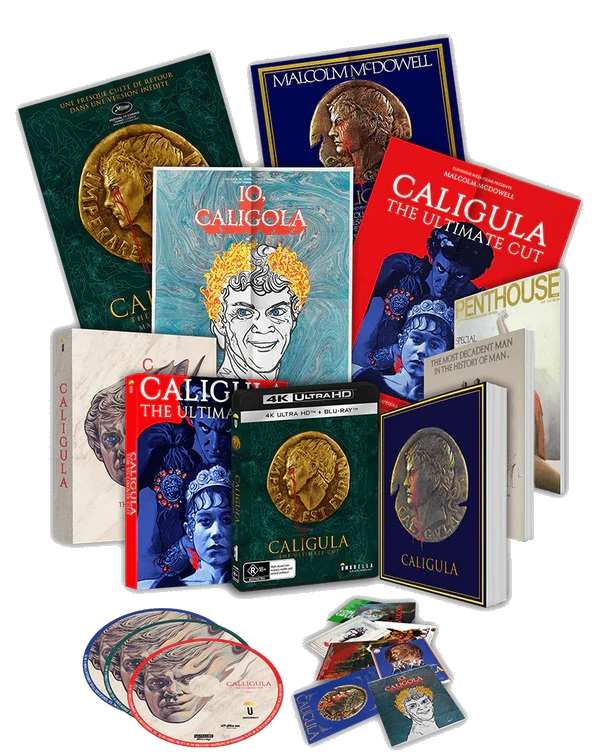
Caligula: The Ultimate Cut fornicates its way to 4K + Blu-ray via a 4 Disc Collector's Set numbered to 5000 units from Australia's Umbrella Entertainment. The four discs are housed inside a hard, black plastic case with a cardboard sleeve. There is also a hard cardboard sleeve that brings in the discs and all of the goodies associated with this film. There are hardcover books, softcover books, poster cards, foldable posters, a Penthouse Magazine, and more. The artwork on the case features a green background with the bloody-headed coin of Caligula. The soft cardboard sleeve features new artwork in red and blue of Caligula and Helen Mirren. The hard cardboard outer shell features the face of Caligula melting away.
Video Review
Caligula: The Ultimate Cut arrives in a stunning new transfer, presented in a 2.00:1 aspect ratio that adheres to the original intended frame used during the film's production in 1976. However, while the film’s appearance is a vast improvement over any prior release, it’s important to judge it on its own merits, rather than as a direct comparison to its infamous 1980 theatrical cut. This new version isn't just a cleaned-up restoration; it's an entirely reimagined film, made from unused original camera negatives and crafted with a careful eye for detail. The visual presentation of The Ultimate Cut is nothing short of miraculous, considering the state of the original footage. Every frame looks pristine, free of significant age or wear as if the film were made recently. The colors are vibrant, the textures are rich, and the overall sharpness is well above what anyone might expect from a production dating back to the mid-'70s. Yet, it’s important to remember that Caligula was filmed with very specific limitations, and those limitations are present here.
That said, the Ultimate Cut excels in presenting these limitations with finesse, and the transfer does not let them hinder the experience. It’s a testament to the skill of the restoration team that, despite these inherent photographic choices, the film looks far better than any previous iteration. The images appear vibrant and full of life, particularly the opulent set designs and costumes that were once overshadowed by the film’s infamous reputation for excess. It’s remarkable to witness how much better the film looks in this new version—Caligula now exudes a grandeur that belies its troubled history. In a way, this transfer does not just restore a film but transforms it. The unevenness of the original production—the flatness of the framing, the over-reliance on zooms—is now part of the film’s unique character, rather than a flaw. Where the visual style once felt like an impediment, it now provides an oddly fitting texture to the extravagant and morally decadent world that Caligula inhabits. The often-stifling aesthetics, while grounded in the realities of 1970s filmmaking, somehow add to the film's sense of entrapment and excess.
For those who have seen the film in earlier formats, this release represents an unequivocal leap forward. The new transfer highlights Caligula’s lavish production values—its massive sets, intricate costumes, and sumptuous lighting; all in ways that make the spectacle even more intoxicating. It’s an upgrade that completely redefines what Caligula can be as a cinematic experience. While the flaws of the original production are still inherent in the visuals, this version gives the film the clarity and respect it so desperately needs. The result is an Ultimate Cut that stands as a revelation, especially for viewers who may have dismissed Caligula as nothing more than an exploitative, chaotic mess. It’s a vast improvement that brings the film back from the fringes, making it not just watchable, but occasionally visually compelling in its own right. If nothing else, this release proves that sometimes, a film that seems beyond redemption is merely waiting for the right context to reveal its worth. In short: this is the Caligula we never knew could exist, and it looks better than we ever imagined it could. A must-see for any fan of controversial cinema, historical epics, or the process of film restoration.
Audio Review
Caligula: The Ultimate Cut is not just a visual transformation; it is a sonic rebirth. The film arrives with an entirely new DTS-HD MA 5.1 sound mix, which delivers an immersive and compelling audio experience that brings the film's reconstructed vision to life. That said, this new DTS track is only on the Blu-ray by mistake where the 4K Disc has a lossy Dolby Digital track that might sound like an oddball sound design for those with big setups. It's an issue that Umbrella is aware of and that they are in the process of fixing. However, the new mix, alongside a fresh score by composer Troy Sterling Nies, does what the original 1980 release never could: it unifies the disparate elements of Caligula into a more cohesive and emotionally resonant piece of cinema. For anyone familiar with the original Caligula, the sound mix was a point of contention. The 1980 version was notorious for its extensive use of post-production dubbing, with many of the film’s primary performances; especially those by Malcolm McDowell, Helen Mirren, and Peter O’Toole—replaced by voice actors. This artificiality often pulled viewers out of the experience, breaking the immersion and distorting the emotional impact of the film’s stellar cast. In The Ultimate Cut, however, reconstructionists Thomas Negovan and Aaron Shaps have gone to great lengths to restore the original on-set audio. As a result, the voices now align with the actors’ performances, offering a rawer, more intimate connection to the material. The film finally feels like it was meant to be heard this way, with each character’s voice resonating with authenticity and emotional depth.
Nies' new score is another revelation, as it elegantly complements the film's historical and psychological weight. The score is subtle yet striking, creating a darkly atmospheric backdrop that is both haunting and propulsive. Where the original score, composed by Bruno Nicolai, felt at odds with the tone of the film; often feeling overly dramatic or misplaced; Nies’ work gives the narrative a modern yet historically grounded texture. Using only instruments available during the film's original production era, Nies’ score avoids modernity's traps while still feeling fresh, creating a sense of continuity with the past without feeling anachronistic. The 5.1 sound mix itself is a meticulous reconstruction, and it shows in every aspect. Dialogue is crisp and clear, with every word. Once obscured by dubbing, it is now delivered with clarity and emotional weight. The film’s more intimate moments benefit from this attention to detail, as the subtle inflections in the actors’ voices are now fully realized. The rear channels are subtly used to create an enveloping atmosphere, bringing a new depth to the film’s soundscape. From the whispers of conspirators plotting in the shadows to the chaotic, fevered moments of imperial decadence, the sound mix is rich, full-bodied, and appropriately immersive. Caligula: The Ultimate Cut delivers one of the most ambitious and successful sound reconstructions of any film in recent memory. This new version of Caligula isn’t just a visual triumph; it’s an auditory one as well. So when the correction is made available we'll recertify our rating.
Special Features
There are over 300 minutes of bonus features included in this big box set. There are five different cuts in the film. 4 audio commentaries both new and old, brand new interviews with the cast and crew, along with a ton of archival featurettes. Notably, one of my own interviews with McDowell and Negovan has made this release and you can all view it in HD video.
- Caligula: Ultimate Cut (173 Mins.)
- Unrated Uncensored Cut (156 Mins.)
- The Italian Cut (124 Mins.)
- Australian Rated Cut (102 Mins.)
- Pre-Release Cut (153 Mins.)
- New Audio Commentary with Heather Drain
- Audio commentary with actor Malcolm McDowell, moderated by Nick Redman
- Audio commentary with actress Helen Mirren, Alan Jones, and James Ellis Chaffin
- Audio commentary with on-set writer Ernest Volkman (interviewed by Nathaniel Thompson)
- Caligula: The Rise, Fall, and Resurrection Video Essay
- Thomas Negovan and Aaron Shaps Discuss The Ultimate Cut
- Thomas Negovan on Caligula at Cannes
- NEW Interview with Malcolm McDowell and Thomas Negovan at Fantastic Fest with Bryan Kluger
- NEW Post-Screening Interview with Malcolm McDowell and Thomas Negovan at Fantastic Fest
- The Guccione Scandal
- The Making of Caligula
- The Orgy Of Power
- Trailer
- 249-page Hardcover book of essays, interviews, and artwork
- 424-page Softcover book of screenplays and the novelization of the film.
- Reprint of the May 1980 Penthouse Magazine with Caligula as the Feature
- 8 Poster Cards
- 2 Caligula Fold-out Posters
Caligula: The Ultimate Cut is an achievement of restoration and re-imagining. While it may never lose its reputation for controversy, this new version allows viewers to finally experience the film as it was always meant to be seen: as a tragic, visceral, and at times fascinating portrayal of a leader whose lust for power mirrors the excesses of the empire he ruled. The new 4K image and the multiple cuts are simply irresistible to look at and the new 5.1 DTS-HD audio track on the Blu-ray sounds amazing. The unfortunate flub might have Caligula taking action in a harsh manner back in the day, however, Umbrella is hard at work with a fix and replacements as we speak. There are loads of new and vintage extras to occupy hours of entertaining time - including an extra with yours truly - Bryan Kluger. For any cinematic aficionados out there - when the audio problem is solved this is a MUST-OWN
We'll report on the replacement discs as soon as they're available. Until then our final recommendation will remain vacant, but this set is impressive despite the glitch.
-
 Turbine Gasses Up For Texas Chainsaw Massacre 4K UHD Mediabook Legendary BundleBy:
 -
 Strange Bedfellows: Why Horror is a Natural Fit for 4K UHD & Blu-ray Physical MediaBy:
 -
 Turbine Is Back In Action for John Watts’ ‘Clown’ on 4KUHD Mediabook November 13th!By:
 -
 The Horror of 'Clown in a Cornfield' Comes Home With A 4K UHD SteelBook from RLJE Sept. 9th!By: