The Project A Collection - 4K Ultra HD Blu-ray (Deluxe Limited Edition)
4K UHD Review By: Billy Russell
Jackie Chan fans unite, as Project A and Project A Part II receive the deluxe box set treatment from 88 Films. The two pictures remain classic entries in Chan’s massive, sprawling filmography—Project A in particular a seminal, career-defining entry that rewrote all the rules as it rocketed to international success and universal acclaim—with gorgeous packaging, in-depth features and audio/visual transfers that outdo themselves at every turn. This set is a Must Own. 

Storyline: Our Reviewer's Take

Like lots of people my age, I first became acquainted with Jackie Chan through Rumble in the Bronx. Rumble in the Bronx felt like a big deal. It felt like a momentous occasion. And I remember the marketing campaign leading up to its release, with the ads touting that it starred Hong Kong’s action star who did his own stunts! I saw it and, of course, loved it, but outside of a few others in his filmography, I kind of forgot about him in favor of the Stallones and the Schwarzeneggers my young American brain was used to. I mean, I liked Rush Hour just like everyone else did and I would be among the first to agree that Chan had a natural movie star’s charisma and unbridled talent for creating balletic action sequences, but what did I know? I hadn’t even seen his best work yet.
It was during the COVID-19 pandemic that I really became acquainted with Chan’s work. As a break from the tedium of being inside all day, a friend of mine rented out a movie theater and invited only her closest friends to attend this special birthday screening of one of her favorite movies. We were all spaced out, ten seats apart, masked up and a few early lucky ones of us had even been vaccinated through part of an early rollout. And we watched an early Jackie Chan flick: Wheels on Meals.
Honestly, I think this was the first Hong Kong production of Jackie Chan I’d ever seen. And, brother, I was hooked. I thought it was incredible. The lightness of the story. The slapstick. The gentle good humor. The death-defying, incredible stunts—not just from Chan himself, but from the other two of the so-called “The Brothers,” Yuen Biao and Sammo Hung. Jackie Chan has an onscreen persona, meticulously crafted over the decades and he can easily lead a movie on his own, but there’s something irresistible about the chemistry these three have together. I asked my friend where to start because I was going to spend the rest of the pandemic mainlining Jackie Chan movies and she told me to start with Project A, another “Three Brothers” picture, and that after that I was in for banger after banger after banger. My year of Jackie Chan films was a wild ride.
Project A is often considered the first fully realized Jackie Chan movie that had gone on to define his filmography throughout the 1980s and 1990s. Before this, he’d had a number of hits and he’d long since ditched his Bruce Lee knockoff movies in favor of a goofier, more likable hero who’s always looking for a way out of trouble, instead of into it, but Project A amplified all of these elements to their next logical evolution. It was more ambitious than anything he’d ever made, and the fighting style adopted a sort of naturalism to it, instead of the stagey kung-fu stylings of yore with clearly marked choreography. The fighting style here looked improvised (even though it was painstakingly rehearsed in advance) and crafted that look we all know and love, where Jackie Chan has been called the Fred Astaire of his time. The Buster Keaton. The Charlie Chaplin. He even has an extended riff on a classic Harold Llyod stunt, dangling precariously from a clocktower. According to Chan, the clock stunt was only coincidentally similar to Harold Lloyd, and when others pointed out the comparisons to classic silent films, he embraced it when he saw how much they had in common. So, the climax of the sequel has a much more intentional riff on Buster Keaton facing down a falling façade.
Without hyperbole, Jackie Chan has an earned placement among those names. His dedication to the craft is unparalleled. There is no “Jackie Chan of today.” There’s only ever going to be one Jackie Chan, and you can thank Project A for it. Beyond Chan’s iconic stylings and screen persona, Project A has the chemistry I adore from the other two of the “Three Brothers.” Yuen Biao is an acrobatic madman who can twist and turn and leap from ledge to ledge with the grace of an Olympic champion. Sammo Hung is the goofiest of the three, larger in stature but capable himself of incredible stuntwork. All three on screen together, to me, is a match made in heaven. While I don’t think Project A is his “best” film (that would probably be Police Story), it is among his most charming, an effort that appears effortless at first, but upon each new viewing reveals more and more complexity to the craft.
The story, such as it is, which in classic Chan fashion is not much more than a loose framework to get from one exciting sequence to the next, involves a slobs vs snobs story, with sailors against police, in the late 19th century, who must put aside their differences in order to battle vicious high sea pirates. Other complications ensue along the way, like kidnappings with hostages that need rescuing and corrupt police officials that need a thorough butt-kicking from Chan, followed by a finger-wagging to show how much he cares about society as a whole. He’s beating up the bad guys, but most importantly, he’s fighting for you, the little guy. Unlike many of his films, here isn’t playing someone named “Jackie”. His name is Dragon.
Like Police Story, Chan puts in some of his best work in response to a professional failure he’s just come hot off of. In both instances, he tried and failed to make a crossover into the United States, then came back to Hong Kong cinema with a renewed need to prove himself as a storyteller unlike anyone else. Project A was a tremendous hit. While the story feels secondary to the spectacle, what spectacle! And the story is captivating enough, and funny enough, to take us along for the ride without complaint. There are a ton of laughs along the way, more than enough gasps, and a palpable chemistry between Chan the entire cast. I always try to judge a movie and its plot for what it sets out to do and how well it accomplishes its goal. This ain’t Citizen Kane. To me, the film delivers on its promise, and begrudging it for not having the traditional benchmarks of a “great” film like character development, story arcs, etc. is a silly bone to pick. Look, you’re going to be wildly entertained, which is the movie’s ultimate goal. It’s a movie about Jackie Chan and his pals kicking pirate ass. Those scenes, as promised, are amazing. A sight to behold.
Project A Part II is not held in as high regard as its predecessor and it does sadly lack the chemistry I adore from Biao and Hung, but for my money, Part II was made at a time when Chan could do no wrong. Just about every movie he made during this era was a winner, and the sequel doubles down on everything that made the original great. The story has added complexity and showcases his growth as a filmmaker, and the stunts themselves (the main attraction) are even more breathtaking than before.
When I refer to the stunts as “breathtaking” I want to be clear here that his movies have among the most fantastic stunts ever committed to celluloid. The punches, the kicks, the falls, the crashes, the leaps and bounds across buildings, they elicit a sense of awe and childlike wonder from their audience. I watch his movies with the same mouth-agape facial expression you’d have to watch some skateboarding video, seeing someone at the top of their game pulling off inhuman skill with expert precision. Watching Jackie Chan perform a choreographed fight scene is like watching LeBron James play basketball. They take the extraordinarily difficult and make it look almost effortless. They make the inhumanly possible look somehow attainable.
Project A Part II was made four years after the original. While the original was responsible for Jackie Chan refining his vision, the sequel solidifies that vision. The direction is more assured and contains many of the trademarks of his later works: He sings the theme song, there’s a blooper reel over the ending credits and both regular cast collaborators Bill Tung and the always-lovely Maggie Cheung are along for the ride. The addition of Tung and Cheung help it feel like Police Story: Pirates.
The sequel takes place immediately where the original film ends, with the surviving pirates picking through the wreckage of the climactic battle that ended the previous story. They swear a blood oath of revenge against Dragon and his police officer pals and the rest of the film is spent seeing Dragon evade his would-be assassins in thrilling chase sequences, fight scenes and creative action set pieces, one after the other.
Although it’s impossible to deny the lasting impact and legacy of Project A, my personal preference is for Project A Part II, which feels more sophisticated and assured in its filmmaking. There’s a certain appeal to the original film’s rough-around-the-edges scrappiness but there’s also something exciting in seeing the follow-up and witnessing Chan’s evolution not only as a stuntman and performer but as a visual storyteller. The cinematography is better and the composition of individual shots is more complex, but both films share a common thread of not being any better made than they need to be. We’re not here to witness a showcase of intricate camerawork and lighting effects. We’re here to see elaborate fight scenes and stunts that are meant to leave our jaws on the floor. The filmmaking techniques need to serve that, not overshadow it. Both films have the ability to invite us to leave our brains at the door and not overthink the story. We give ourselves to it entirely.
That, my friends, is movie magic.
Vital Disc Stats: The Ultra HD Blu-ray
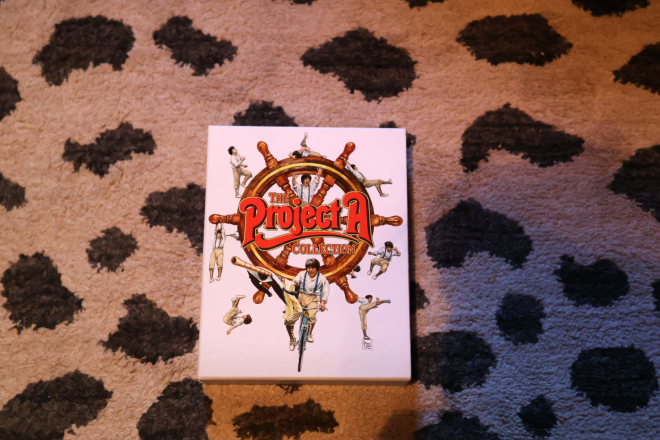
The packaging for Project A/Project A Part II is absolutely insane and the bells and whistles are seemingly never-ending, with a new surprise waiting for me at every turn. Each movie is housed in a standard case on both a 4K UHD Blu-ray disc and a standard Blu-ray. Both cases contain reversible covers featuring new artwork from “Kung Fu” Bob O’Brien and original cover artwork from the Hong Kong posters. Inside each case is a collection of lobby cards, replications from their theatrical runs.
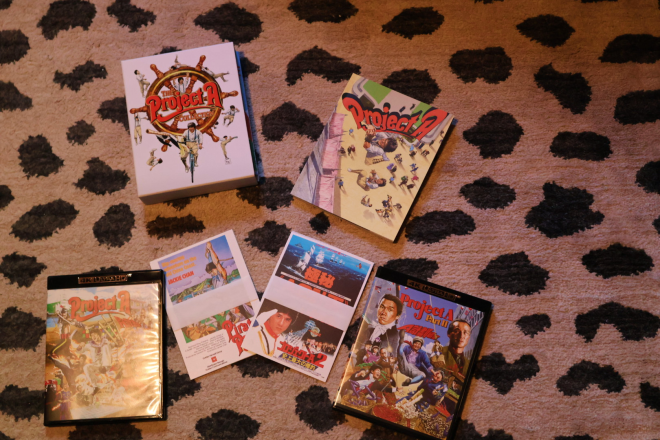
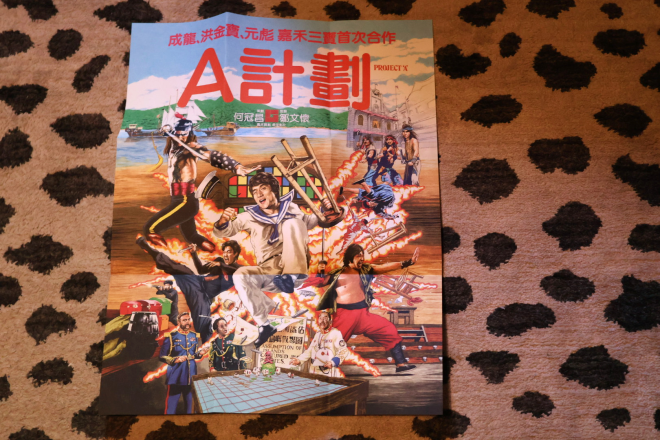
The box set contains a 100-page illustrated collector’s book containing production notes on both films, essays by Thorsten Boose and Paul Bramhall, and an interview with Roberta Chow. There are also two full-sized, double-sided posters containing new and original artwork on either side.


Video Review
Project A never really looks any better than it has to, which isn’t to say it looks bad (it doesn’t), it just has a style that appears, on its surface, to be a lack of style. Shot composition isn’t very complex. Depth of field is nonexistent. Much of the film is shot with a wide-angle lens to ensure most of the frame is in focus. Some of this is because Jackie Chan and his team behind the camera had not yet fully become confident visual storytellers, but a lot of it is a wise aesthetic choice to minimize the viewer’s awareness that they’re watching a film at all. Takes are long without many edits, which is not only easy on a viewer’s eyes, but it allows them to realize that what they’re seeing is real. When you see a stuntman fall of a balcony and land on their belly fifteen feet below without cutting, you know you’re seeing the real deal.
Project A Part II is much more elegant in its visuals, but it wisely commits to many of the same decisions its predecessor had set—nearly invisible filmmaking techniques during the action sequences—but during the quieter moments filled with exposition to fill in key details, or dialogue to progress the plot, we begin to see a more assured director behind the camera.
The original film was shot in 1983 but due to a lower budget and other limitations, it looks like it was shot in the mid-to-late 70s. The sequel was shot in 1987 but due to improvements in filmmaking techniques, it looks like it was actually made during that time. The film stock is crisper, and colors are richer, but it does also suffer from a Hong Kong stylistic decision a lot of films of the era made where they blasted everything with a fog machine to give it a softer, dreamier quality but had the negative side effect of looking butt ugly. Thankfully, Part II uses this sparingly and the majority of it looks pristine.
Both the Blu-ray and the 4K UHD look great, but the 4K UHD gets the edge through its Dolby Vision HDR grading that enhances just about every positive detail. These are colorful movies populated with period costuming in greens, purples, red, blues, you name it, and the enhanced color spectrum is going to push your TV to its limits.
Both films are showered in a fine layer of film grain, evident throughout.
While the Project A films might not be the most gorgeous pictures ever made (I don’t think I could say that of any of Chan’s classics), 88 Films’ work on them is clearly noticeable. I looked through the materials provided in the box set and tried to do some additional research on the video presentation, but the details are sadly scant. I’m unsure if the films were remastered from their original 35mm camera negatives, but given how sharply detailed they are, I think that’s a safe assumption.
Audio Review
Project A and Project A Part II both come with a variety of mixes available: They both feature a newly-commissioned Dolby Atmos mix and DTS-HD MA mono mixes. Part II has alternate Japanese version mixes to the mono version of the sound option.
I toggled back and forth between the mono mixes and the Dolby Atmos mixes on both films and all I can say is… wow. The DTS-HD MA mono mix is going to be great for purists who want the original mix are going to be very happy. It’s crisp, complex, layered wonderfully and dialogue is always clear and favored throughout, even during the rowdiest action sequence either film has to offer.
The Dolby Atmos mix is an absolute work of art, on both films. It remains faithful to the original mono mix by mostly being a front-heavy affair on the soundstage. The first film a little more liberal with the effects it throws into the rear speakers and the second film is a little stricter with it. No matter, I was fine with both, but both films favor taking the front sound stage and expanding it into the height speakers, giving it this symphonic presence, like a half dome of enveloping sound. A few well-time effects made their way to the rear height speakers with such precision and such intentional usage that it would cause me to turn to see if something in my screening room had actually shattered.
The strongest aspect of the Dolby Atmos mixes is in their 3D soundscape. The films’ abilities to cast effects and give the illusion of occurring outside of my speakers was, honestly, something I’ve really only encountered a number of times. A lot of Atmos mixes wind up sounding like a 5.1 surround mix on steroids, but these films subtly utilize their ability to pitch and project effects in a way that truly transcends itself.
The mono mixes are fantastic, and I recommend them for purists, or for folks who don’t have an Atmos-capable system. For those with a sound system capable of playing back a Dolby Atmos signal, you’re in for a treat.
Special Features
88 Films’ release of Project A and Project A Part II is staggering in the amount of special features it contains. Fans of Jackie Chan movies and fans of Hong Kong cinema as a whole are going to have hours and hours of supplements to make their way through. Each film contains an alternate version, too—the first film contains a longer Taiwanese cut that adds more conflict between Jackie Chan’s character and Yuen Biao’s, while the sequel has a shorter “international” version that truncates the plot to quicken the audience’s arrival at the exciting parts. In both cases, I recommend the original Hong Kong cuts, although having both versions available is nice to satisfy curiosity.
Project A
- Audio Commentary by Frank Djeng and FJ DeSanto
- Audio Commentary by Frank Djeng
- Lunar New Year Introduction by Jackie Chan (HD 3:32)
- New Interview with Stunt Double Mars Cheung (HD 14:35)
- Archival Interview with Stunt Double Mars Cheung (SD 15:26)
- Interview with Lee Hoi-san (SD 22:03)
- Interview with Yuen Biao (SD 18:07)
- Interview with Dick Wei (SD 13:57)
- Interview with Michael Lai (SD 17:27)
- Interview with Edward Tang (SD 15:11)
- Project Collector with Paul Dre – A look into one of the largest collections of Jackie Chan memorabilia (HD 16:17)
- Outtakes (SD 24:03)
- Japanese Version Ending (HD 2:24)
- The Making of Project A (SD 11:45)
- Trailers
- Stills Gallery
Project A Part II
- Audio Commentary by Frank Djeng and FJ DeSanto
- Interview with Anthony Carpio (HD 25:25)
- Interview with Chan Wai Man (SD 19:40)
- Someone will Know Me – Archival documentary featuring Jackie Chan and his stunt team (SD 13:12)
- Full Screen Jackie Chan Recording Session – Jackie Chan signing the film’s theme song (SD 2:33)
- Trailers
- Stills Gallery
Inside the Limited-Edition Box Set
- 100-Page Booklet
- Replica Lobby Cards
- Double-Sided Foldout Posters
- Slipcase with brand-new artwork from Kung Fu Bob
The work 88 Films has put into the Project A films is nothing short of staggering—from the video presentations graded in Dolby Vision, the newly-commissioned Dolby Atmos mixes, the special features (both new features and old one ported over from previous releases) and the packaging itself. Truly, this was a labor of love and it shows. Both of these films were important in the formation of Jackie Chan’s status as an international superstar and this release delivers on its reputation. Now on 4K UHD, we can enjoy Project A in glorious 4K. Each film looks terrific on disc with excellent audio to match. Then we come to the hours of excellent bonus features to kick through after the double-feature is over.
Whether you consider yourself a casual Jackie Chan fan, a diehard, or something in between, this set is a Must Own.
-
 Strange Bedfellows: Why Horror is a Natural Fit for 4K UHD & Blu-ray Physical MediaBy:
 -
 Turbine Is Back In Action for John Watts’ ‘Clown’ on 4KUHD Mediabook November 13th!By:
 -
 The Horror of 'Clown in a Cornfield' Comes Home With A 4K UHD SteelBook from RLJE Sept. 9th!By:
 -
 Turbine Sinks Their Fangs into Our Necks With NEW Renfield and Abigail 4K UHD Mediabooks!By: